
Effective collaboration is the backbone of any successful team, but too often, it’s slowed down by disconnected tools, endless email threads, and scattered information. Read on to learn more.

The Hidden Cost of Campaign Reporting
Most reporting problems do not start with the reports themselves. They start with what sits behind them.
If your team is still pulling campaign data from multiple platforms, stitching it together, and turning it into weekly or monthly updates, the issue is not effort. It is structure. Modern marketing runs across too many systems for manual reporting to keep up. Paid media, CRM data, analytics platforms, and internal dashboards all live in different places, and rarely agree without friction.
That friction shows up quickly. Campaign performance reports arrive later than they should. Teams spend hours preparing automated reports that are not truly automated. And the people responsible for growth end up acting on information that is already slightly outdated.
It sounds operational, but it is not. It is a performance issue.
When reporting slows down, optimization follows. That affects conversion rate, limits visibility into what drives customer lifetime value, and makes consistent revenue attribution difficult to maintain. Even small delays in feedback loops can distort decision-making over time, especially when budgets scale.
Then there is the issue most teams quietly work around: data quality. When reports depend on manual inputs or loosely aligned definitions, confidence in the numbers starts to slip. Teams double-check instead of acting. Discussions shift from “what should we do next?” to “can we trust this?” At that point, even strong performance data becomes harder to use.
For a growing business or a scaling digital agency, this becomes more than a reporting inconvenience. It turns into a structural constraint. More channels bring more cross-channel data, more moving parts, and more opportunities for inconsistency. Keeping reporting aligned with total advertising goals becomes harder with every new platform added to the mix.
This is where more teams are choosing to automate campaign reporting, not to save a few hours, but to regain clarity and control. The shift is less about efficiency and more about making sure campaign performance reports are accurate, timely, and actually usable.
The rest of this article breaks down what effective campaign reporting automation looks like today, why it has evolved beyond rigid dashboards, and how teams are implementing it in practice without adding complexity.
Why Campaign Reporting Breaks at Scale
Reporting issues rarely come from a lack of tools. Most teams already have plenty of those. The problem usually sits deeper, in how those tools are connected and how reporting is structured behind the scenes.
Early on, things tend to work just fine. One or two channels, a few dashboards, and a steady stream of campaign data that is still easy to manage. At that stage, manual reporting is not ideal, but it is workable. Spreadsheets stay organized, definitions are consistent, and marketing teams can draw relatively clear insights into performance without too much friction.
Then growth happens.
As the business grows, reporting quietly becomes more complicated. New channels are introduced, paid search expands, CRM data starts playing a bigger role, and attribution becomes harder to ignore. What used to be a straightforward reporting process turns into something else entirely. Instead of simply collecting numbers, teams find themselves trying to reconcile differences across systems that were never designed to align.
This is where the first cracks appear.
In fact, research shows the issue is widespread. According to Marketing Dive (2024), 87% of marketers report ongoing campaign performance challenges, often tied to fragmented data, inconsistent measurement, and reporting limitations. What starts as a manageable process quickly becomes difficult to scale.
Fragmented Data Across Systems
In most cases, the issue is not a single platform. It is the combination of many.
A typical setup now includes multiple analytics platforms, ad accounts, CRM tools, and often a centralized data warehouse. Platforms like Google Ads and Meta Ads capture paid performance, while CRM systems such as HubSpot track lead and pipeline activity. On the analytics side, tools like Google Analytics and visualization tools like Google Data Studio aim to structure that data. Some teams go further and push everything into environments such as Google BigQuery to centralize reporting.
That helps to a point, but it rarely solves the underlying issue.
Each system still operates with its own definitions, timeframes, and attribution logic. Even when data is centralized, inconsistencies remain. In practice, many teams, especially in a digital agency environment, end up relying heavily on individual ad platforms, which introduce their own limitations and blind spots.
The Limits of Static Reporting Models
As complexity grows, many teams try to standardize reporting through templates and fixed dashboards. These often include:
Weekly campaign performance reports.
Channel-specific automated reports.
A central demand gen report.
They provide structure but are inherently rigid. They struggle to adapt when:
New channels are introduced.
Reporting requirements change.
Stakeholders ask new questions.
More importantly, they rarely capture the full picture. Modern marketing depends on multi-touch models, where value is distributed across several interactions. Static reports tend to flatten that complexity into simplified views, which limits insight into what actually drives outcomes like leads generated or pipeline influenced.
Operational Bottlenecks in Marketing Teams
As reporting becomes more complex, the burden shifts to people.
Specialists, whether in-house or in a digital agency, spend increasing amounts of time:
Pulling data from multiple systems.
Cleaning inconsistencies.
Rebuilding dashboards.
Formatting automated reports for stakeholders.
Even highly skilled roles like PPC specialists end up spending hours on reporting tasks that do not directly improve performance.
This is where multi-platform complexity becomes a real cost center. Reporting cycles slow down, and marketing teams operate with delayed feedback. Instead of acting on insights, they spend time preparing them.
Missing the Full View of Performance
Perhaps the biggest limitation is visibility.
When reporting is fragmented, it becomes difficult to connect:
Ad spend to revenue attribution.
Campaign activity to customer lifetime value.
Channel performance to overall marketing performance.
Important signals get lost. For example:
Email performance may not align with paid acquisition data.
Offline conversions from call tracking systems may not be reflected in dashboards.
Custom KPIs remain siloed because they do not fit standard templates.
Without a unified view of cross-channel data, teams are left optimizing in parts rather than as a whole. That makes it harder to align reporting with total advertising goals, especially at scale.
Why This Problem Persists
Many organizations try to fix reporting by adding more tools. In reality, they are adding more layers to an already fragmented system.
Traditional marketing automation and reporting solutions were built to organize data, not to interpret it or adapt to changing conditions. They rely on predefined rules, fixed schemas, and static outputs. That works in stable environments. It breaks down into dynamic ones.
This is the gap that modern approaches aim to close.
Before looking at solutions, it is worth understanding how reporting itself is evolving, and why simply automating existing workflows is no longer enough.
What Campaign Reporting Automation Actually Means Today
By this point, most teams are no longer asking whether they should improve their reporting. The real question is what “better” actually looks like.
For some, it means cleaner dashboards. For others, more frequent updates or standardized templates. Those improvements help, but they do not fundamentally change how reporting works. They still rely on people to move data, validate outputs, and translate results into something usable.
Modern campaign reporting automation goes further than that.
At its core, it is about building a system where automated reports are not just generated on schedule, but continuously updated, validated, and structured around how decisions are made. That includes pulling campaign data from multiple sources, aligning it into a consistent format, and producing campaign performance reports that reflect the current state of the business, not last week’s snapshot.
This is what differentiates true automated marketing reporting from basic automation.
Beyond Scheduled Reports
Traditional automation tends to focus on timing. Reports are generated daily, weekly, or monthly, and delivered in a fixed format. While that reduces some manual effort, it does not address deeper issues such as data quality, inconsistencies, or interpretation.
Modern systems approach this differently.
They are designed to:
Continuously sync performance data across platforms.
Standardize definitions and metrics.
Flag inconsistencies before they reach stakeholders
Adapt outputs based on evolving reporting needs.
The difference becomes more obvious as reporting needs evolve. Leadership rarely looks at performance through a single lens. They may want to understand how customer lifetime value varies by acquisition channel, how the conversion rate shifts across campaigns, or how specific initiatives influence the pipeline over time.
That kind of flexibility is where rigid setups start to struggle. Fixed dashboards are difficult to adapt without ongoing manual work. A more advanced approach to automated marketing reporting absorbs these changes into the system itself, rather than treating them as exceptions that need constant handling.
From Aggregation to Insight
Another key shift is moving from aggregation to interpretation.
Most reporting setups today are good at collecting data. They are less effective at turning it into data insights that drive action. This is where many marketing teams still rely heavily on manual analysis, even if data collection itself is partially automated.
Modern automated marketing reporting closes that gap.
It connects:
Raw performance data.
Context across channels..
Business metrics like customer lifetime value
And translates them into outputs that are easier to act on. This does not replace human judgment. It reduces the time it takes to reach it.
For a digital agency, this can mean delivering campaign performance reports that already highlight what changed and why. For in-house marketing teams, it can mean identifying shifts in conversion rate before they materially affect revenue.
Flexibility Without Rebuilding Everything
One of the biggest misconceptions about agentic automation is that it creates rigid systems. In reality, that is a limitation of older approaches.
Today, effective campaign reporting automation is designed to be flexible.
New channels can be introduced without breaking reporting logic. Custom metrics can be layered in without restructuring dashboards. Inputs from tools like call tracking systems can sit alongside digital performance, and reporting outputs can shift depending on stakeholder needs.
This flexibility is critical in environments where strategies evolve quickly. Reporting should adapt alongside campaigns, not lag behind them.
This is also where many organizations begin exploring more advanced models, including agentic workflows that adjust how reporting is generated based on goals and context.
What This Means in Practice
In practical terms, teams that automate campaign reporting effectively are not just saving time. They are changing how reporting supports decision-making.
Instead of building reports after the fact, reconciling inconsistent data, and explaining gaps in numbers, they operate with continuously updated automated reports, consistent data quality across sources, and clear visibility into marketing performance.
This creates a different dynamic. Reporting becomes part of the workflow, not a separate task that slows it down.
And once that shift happens, the next question is not how to improve reporting. It is how to make it intelligent enough to keep up with the business.
From Automation to Agentic AI (and Why It Matters Now)
If traditional automation helped reduce manual effort, the next wave is focused on reducing manual thinking.
Most existing reporting systems still depend on predefined rules. They pull data, apply fixed logic, and generate automated reports based on what has already been configured. That works when reporting needs are stable. It starts to break down when priorities shift, new channels are introduced, or stakeholders ask different questions.
This is where a new approach is emerging.
Often referred to as agentic AI, this model moves beyond static automation. Instead of simply executing tasks, it can interpret context, adjust workflows, and make decisions within defined boundaries. In the context of reporting, that means systems are no longer limited to producing outputs. They can actively shape how those outputs are created.
Why Traditional Automation Falls Short
To understand the shift, it helps to look at the limitations of current tools.
Most automation today still requires manual configuration of reporting logic, ongoing maintenance when structures change, as well as human intervention to interpret results.
Even well-built systems struggle when new cross-channel data sources are introduced, attribution models evolve toward multi-touch models, or reporting needs extend beyond standard dashboards.
This creates a gap. Teams may have automated marketing reporting in place, but they still spend significant time adapting it to real-world conditions. The system runs, but it does not adapt.
What Agentic Process Automation Changes
This is where agentic process automation becomes relevant.
Instead of relying entirely on predefined workflows, these systems operate with a degree of autonomy. They can:
Adjust how automated reports are generated based on goals.
Incorporate new data sources without requiring full rebuilds.
Interpret shifts in performance data and surface relevant changes.
In practical terms, this means reporting becomes less about maintaining structure and more about guiding outcomes. For example, rather than manually reconfiguring a report when campaign priorities change, the system can adjust its logic to reflect new objectives. Instead of rebuilding dashboards to include additional inputs, it can integrate them into an evolving workflow.
Flexibility Becomes a Competitive Advantage
For growing agencies managing multiple clients, this shift has direct implications because reporting stops being just about visibility. It becomes a lever for speed and authority.
Teams that rely on static systems typically experience delays in adapting reports to new strategies, along with a heavy reliance on manual fixes and adjustments. Not to mention the time spent reformatting outputs to meet client or stakeholder expectations.
In contrast, teams using more adaptive approaches can:
Respond faster to changes in performance data.
Maintain consistent campaign performance reports across environments.
Align reporting more closely with the client’s desired business outcomes.
This is particularly important when reporting needs to reflect metrics beyond surface-level performance, such as customer lifetime value or broader marketing performance indicators.
Why This Matters Now
The move toward more adaptive systems is not happening in isolation. It is a response to how complex marketing has become.
More channels.
More data sources.
More pressure to demonstrate impact... It truly never ends.
There is also a broader shift behind this. According to McKinsey & Company (2023), organizations that effectively use AI in marketing and sales can achieve meaningful improvements in productivity and revenue. At the same time, Gartner (2024) reports that marketing leaders continue to cite data fragmentation and reporting complexity as key barriers to decision-making.
Put those two together, and the gap becomes clear.
Systems that rely on static reporting structures tend to slow things down. More adaptive approaches remove some of that friction and make it easier to keep pace with how the business is actually operating.
Where This Leaves Marketing Teams
For most marketing teams, the takeaway is not that existing tools are obsolete. It is that expectations have changed. Reporting is no longer just about delivering information. It is about delivering it in a way that keeps up with how the business operates.
That is why more organizations are automating campaign reporting with systems that are not only efficient but also adaptable. Systems that can evolve alongside campaigns, rather than requiring constant adjustment.
The next step is understanding what this looks like in practice, and how teams are implementing it without adding unnecessary complexity.
Business Impact: What Leaders Actually Gain
At a certain point, reporting stops being a workflow issue and becomes a business constraint.
When teams rely on manual or semi-automated processes, the cost is not just time. It shows up in delayed decisions, inconsistent visibility, and missed opportunities to act on what the data is already telling you. This is why more organizations are investing in automated marketing reporting, not as a technical upgrade, but as a way to improve how the business operates.
The most immediate impact is efficiency, and it is often more significant than expected. Reporting is one of the few functions that repeats itself almost identically every week. The same data is pulled, cleaned, structured, and presented again and again. According to McKinsey & Company (2023), a substantial portion of time spent on data-related tasks can be automated, particularly in areas like reporting and analysis. When teams begin to automate campaign reporting, that repetitive workload is reduced dramatically.
In practice, the results are tangible. In agency environments using tools like Capably, teams report spending up to 75% less time creating performance analyses and presentations. In more specialized use cases, such as competitive reporting, time savings can reach 90%. Others report saving several hours on each reporting task once workflows are fully delegated. These gains are not marginal. They change how time is allocated across the team.
What makes this meaningful is where that time goes. Instead of producing automated reports manually, teams shift toward interpreting performance data, refining strategy, and improving execution. Over time, this has a direct impact on output quality and campaign effectiveness.
At the same time, reporting becomes significantly more reliable. Consistent data quality across systems reduces the friction that typically slows down decision-making. When campaign performance reports are trusted, they get used. That may sound obvious, but in many organizations, a lack of confidence in reporting quietly undermines its value. Teams double-check numbers, reconcile discrepancies, and hesitate before acting. Removing that friction allows decisions to happen faster and with more confidence.
That speed has a practical impact. Shorter reporting cycles mean teams can react while campaigns are still active, not after the fact. Budgets can be adjusted earlier, weaker channels corrected before they drain spend, and stronger ones scaled with more confidence. Over time, that shows up in improved conversion rate and more consistent marketing performance.
Visibility also improves as complexity grows. With effective automated marketing reporting, it becomes easier to connect campaign activity to outcomes such as leads generated, pipeline influenced, and ultimately revenue attribution. This is particularly valuable in environments that rely on multi-touch models, where understanding contribution across the full journey is essential. Without reliable reporting, those connections remain fragmented.
For both in-house teams and any digital agency managing multiple clients, this clarity changes the nature of reporting. It moves from being a retrospective exercise to a forward-looking tool. Instead of explaining what happened, teams can focus on what to do next.
As complexity increases, this advantage compounds. More channels, more stakeholders, and more data typically mean more reporting overhead. Without automation, scaling reporting requires scaling headcount. With the right approach to campaign reporting automation, teams can expand output without expanding effort. Reporting becomes consistent across accounts, while maintaining the flexibility to adapt to different goals and custom metrics.
This is where the role of marketing teams begins to shift. When reporting is manual, a significant portion of time is spent producing information. When reporting is automated, that time is redirected toward using it. Teams focus less on assembling ad campaign reports and more on improving outcomes, whether that means refining targeting, optimizing spend, or identifying new opportunities for growth.
At that point, the value of automation is no longer operational. It is strategic.
How to Implement AI Automation Without Adding Complexity
Understanding the value of automation is one thing. Implementing it without disrupting existing workflows is another.
This is where many teams hesitate, often assuming that AI-driven reporting requires new infrastructure, technical expertise, or a full rebuild of their current systems. In practice, modern tools are designed to do the opposite. They sit on top of what you already use and start delivering value quickly.
Capably follows this approach. Instead of replacing your setup, it allows teams to automate campaign reporting by layering intelligent workflows over existing tools, including platforms like Google Ads and other analytics platforms.
1. Starting With a Workflow, Not a Blank Page
Rather than building reporting logic from scratch, teams begin with predefined workflows based on real reporting use cases. This eliminates the need to manually design the structure and shifts the focus to execution.
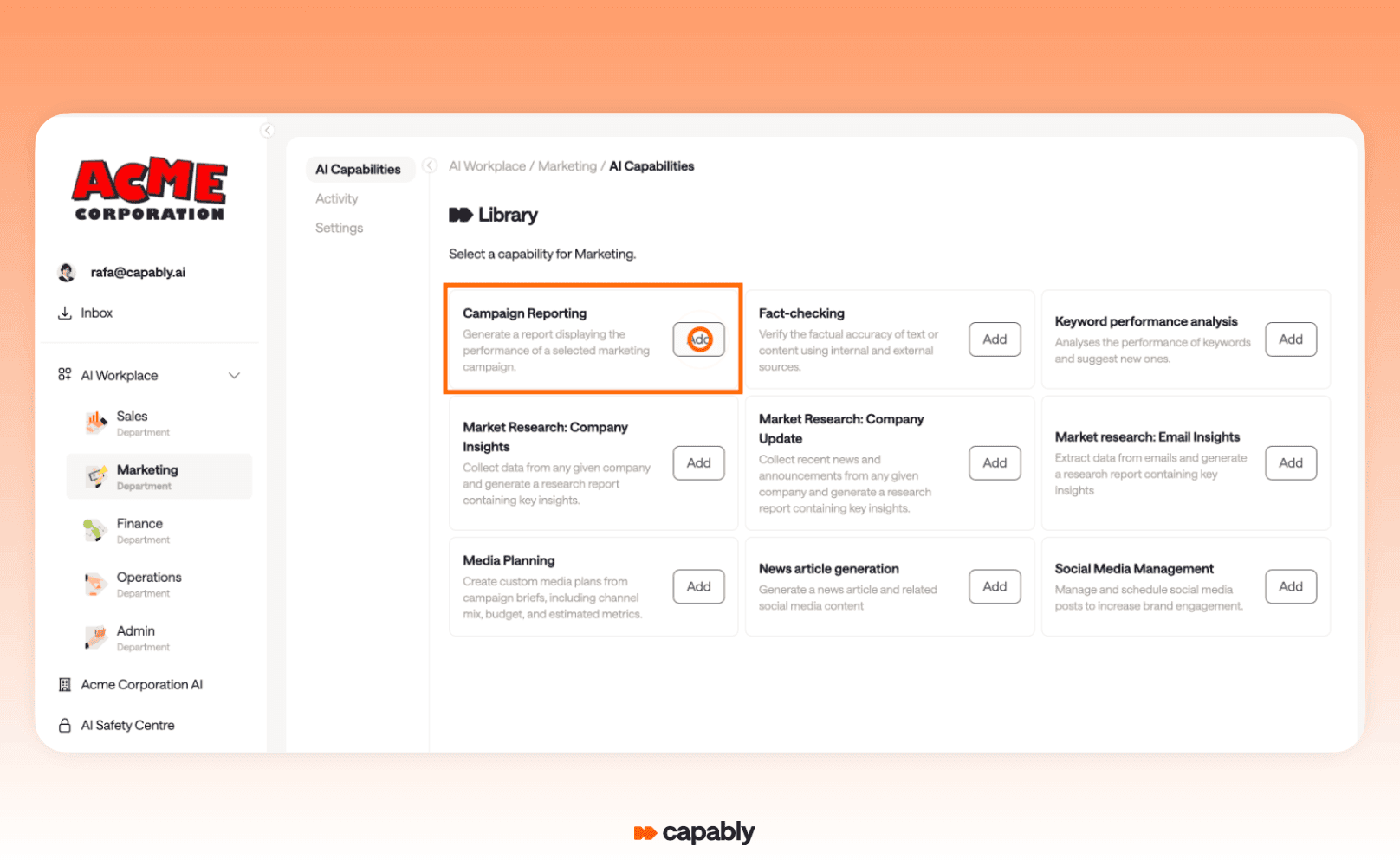
The setup is guided. You select the campaign, define what you want to measure, and the system handles the rest. There is no need to configure complex rules or manually manage data flows. The goal is to produce reliable campaign performance reports without adding operational overhead.
2. Connecting Data and Generating Reports
Once the workflow is in place, connecting data sources becomes part of the process rather than a separate task.
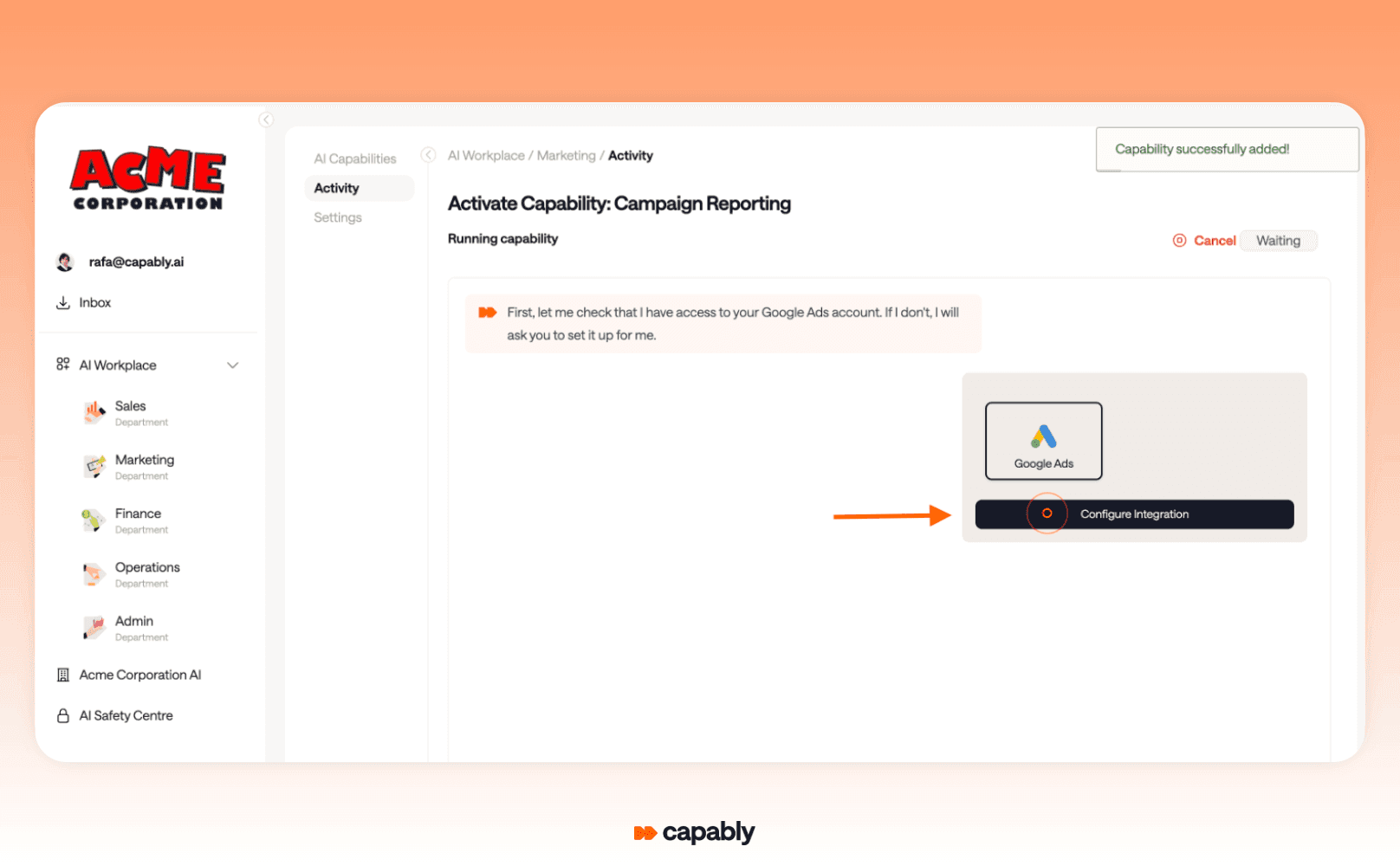
Data from different systems is pulled into a consistent structure, helping maintain strong data quality without requiring manual cleanup. This includes paid channels, CRM inputs, and other sources of campaign data.
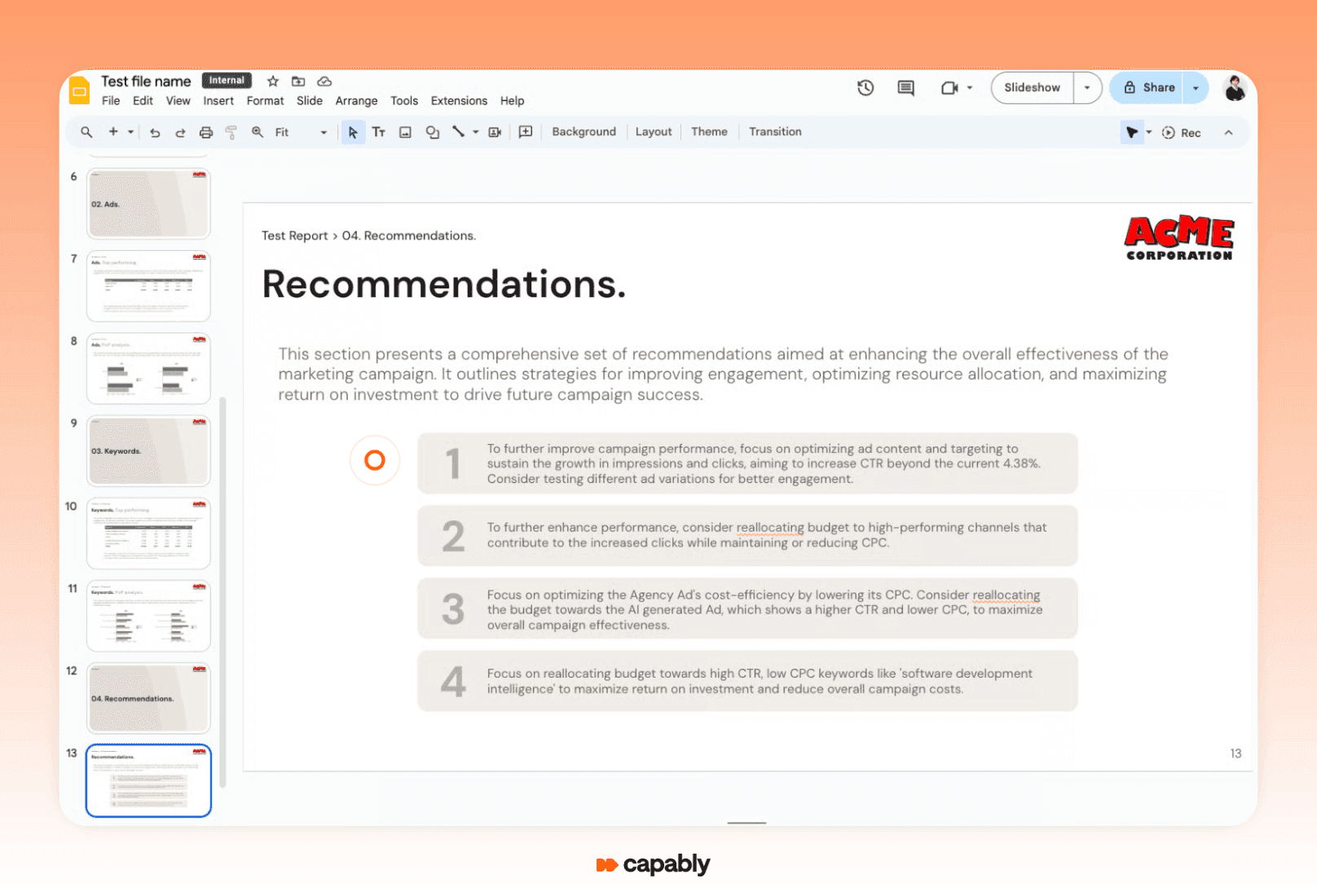
From there, the system generates automated reports in the format you choose, whether a presentation, a dashboard, or shareable output.
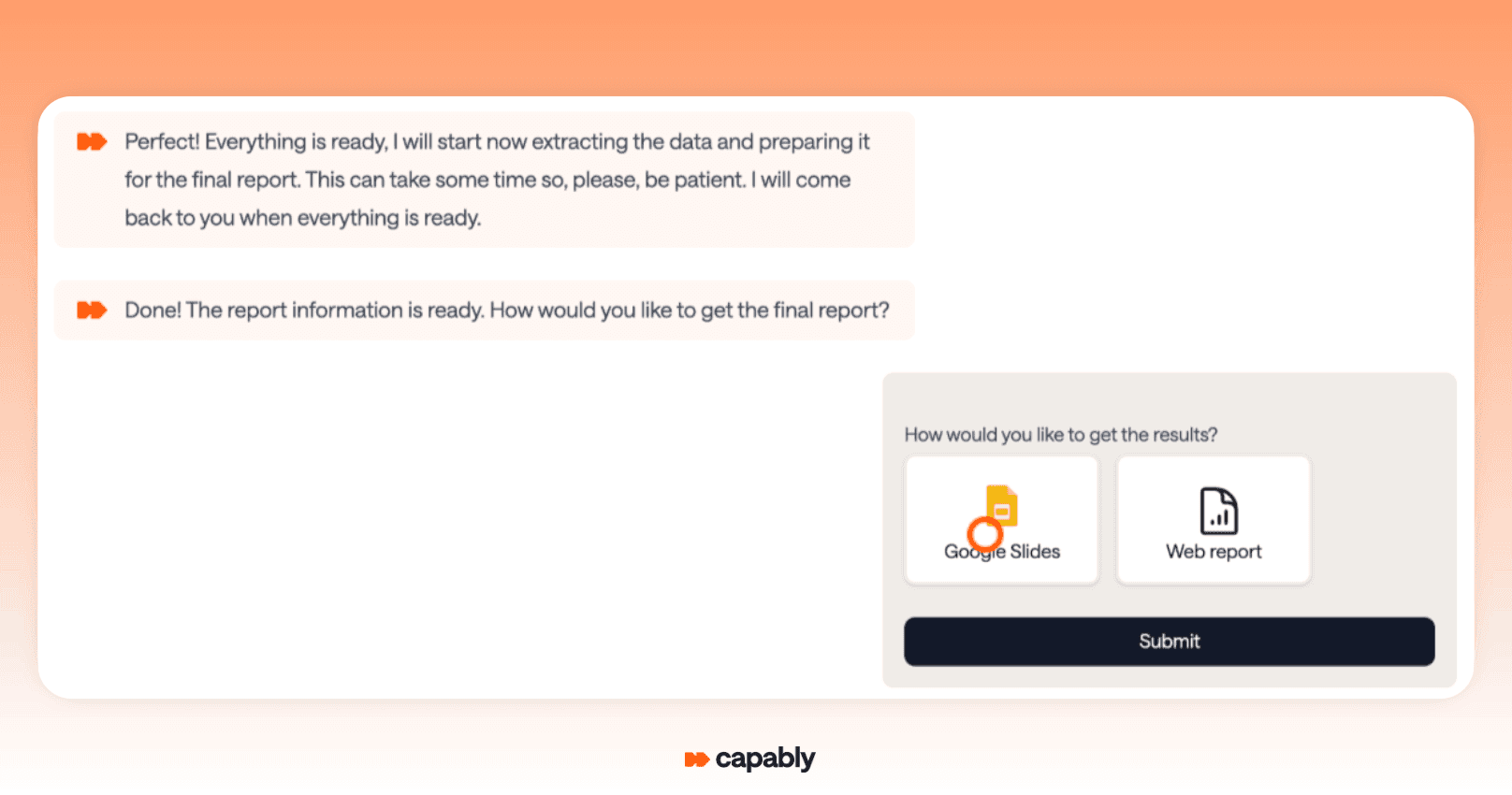
Unlike traditional automated marketing reporting, the system does more than aggregate numbers. It highlights patterns, surfaces changes in performance data, and provides context that helps teams move faster from reporting to decision-making.
3. Control, Flexibility, and Scale
A common concern with automation is loss of control. In practice, teams gain more of it.
You define what matters upfront, including metrics, structure, and outputs. The system operates within those parameters, but it does not remain fixed. As reporting needs evolve, workflows can be adjusted without rebuilding them. If the predefined workflow is not sufficient, you can easily set up a customized one, describing your needs and intentions to the agent in plain text.
This becomes particularly important as reporting expands. A digital agency may need to replicate reporting across multiple clients, while in-house marketing teams may need to extend reporting across channels. In both cases, workflows can be reused, adapted, and scheduled with ease as well as created from scratch, ensuring automated reports are delivered consistently.
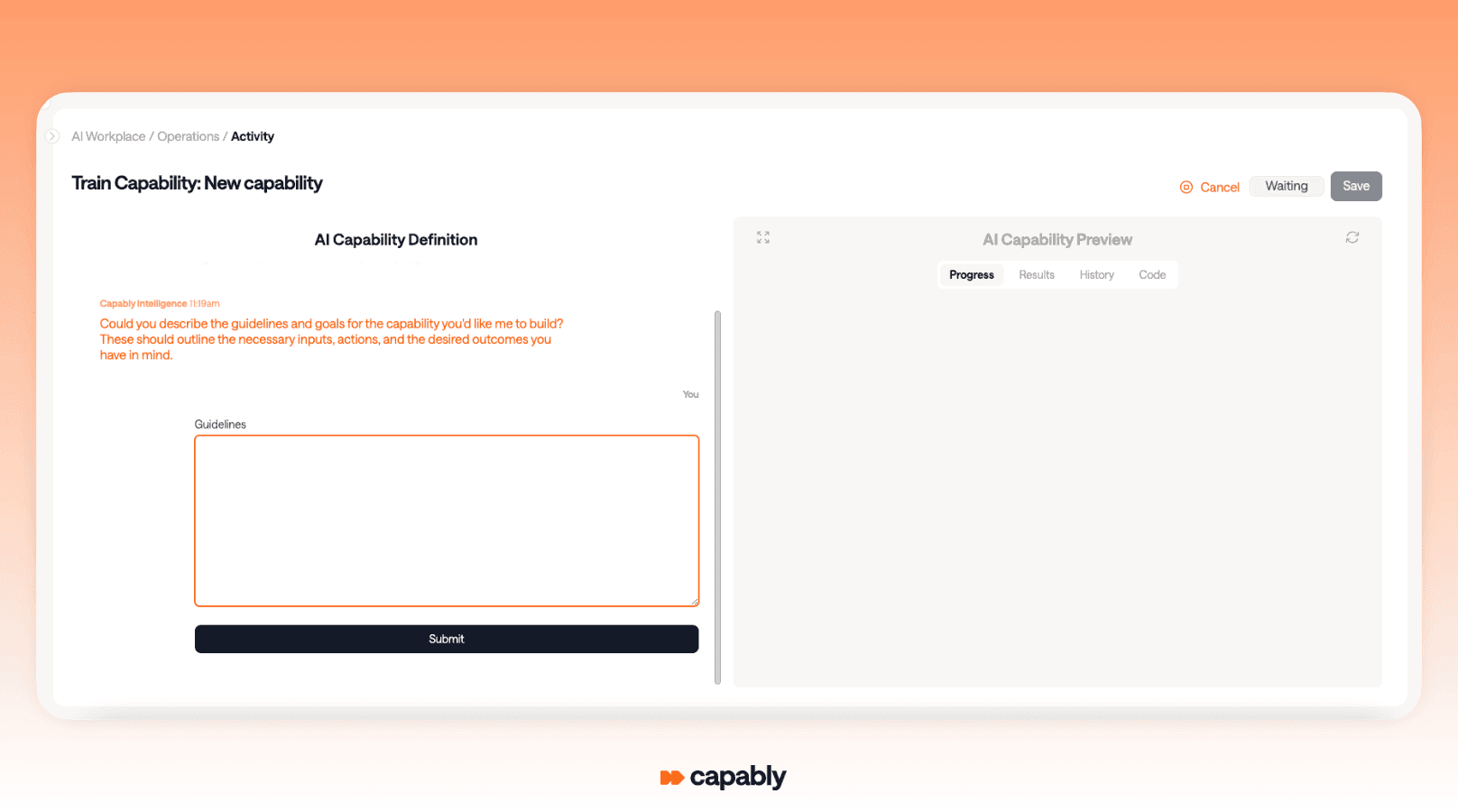
Flexibility is preserved. Teams can introduce custom metrics, incorporate additional data sources, and adjust reporting outputs as their strategy evolves, communicating with the AI agent in the language they understand. The system adapts alongside the business, rather than forcing teams into a rigid structure.
Transition Forward
At this point, implementation is no longer the barrier. The real shift is how reporting fits into the way teams operate. The next step for many leaders is understanding how to implement AI automation in a way that delivers these gains without disrupting existing operations.
The advantage of modern automation is not just that it saves time, but that it does so without adding complexity or removing control.
Conclusion: Smarter Reporting Without the Overhead
Campaign reporting is not going away. If anything, it is becoming more central to how businesses operate. The difference is how it gets done.
What used to be a manual, time-heavy process can now be handled through systems that automate campaign reporting without sacrificing control or flexibility. The impact goes beyond operations. Teams can act sooner, make decisions with greater confidence, and connect activities to outcomes with far greater clarity.
Better reporting is not about cleaner dashboards or faster updates alone. It is about understanding what is actually driving performance. It is about aligning reporting with outcomes like customer lifetime value and revenue attribution, and having access to that clarity when it is still useful, not after the fact.
The alternative is less visible, but it adds up. Slower reporting cycles, inconsistent data quality, and fragmented visibility create friction that builds over time. Decisions take longer, opportunities slip, and teams end up spending more time explaining results than improving them.
Modern campaign reporting automation offers a different path. One where automated reports are reliable, adaptable, and aligned with how teams actually work. Not rigid systems that need constant maintenance, but workflows that evolve alongside your campaigns.
That is where platforms like Capably make a practical difference. Not by replacing how teams think, but by removing the effort required to get to the point where thinking matters.
If reporting has started to feel heavier than it should, that is usually a signal that the process behind it needs to change.
A simple place to start is with one workflow. One recurring report. One process takes more time than it should. From there, it becomes easier to see what automation can actually unlock.
And if you want to see how that works in practice, Capably gives you a way to do exactly that. Not as a theory, but as a working system you can shape, adjust, and expand as your needs evolve.
Continue reading