
Effective collaboration is the backbone of any successful team, but too often, it’s slowed down by disconnected tools, endless email threads, and scattered information. Read on to learn more.

Media planning has quietly become one of the most operationally complex functions in modern marketing, increasingly supported by AI-assisted technology to manage scale and speed. What once lived comfortably in spreadsheets and quarterly cycles now operates within a rapidly evolving tech landscape defined by compressed timelines, fragmented channels, and shifting performance expectations. The irony is that while planning has become more critical to business outcomes, many organizations are still relying on processes that were never designed to move this fast.
For leadership teams, this creates a hidden cost. Manual planning workflows slow execution, introduce risk, and limit opportunities for meaningful process optimization without adding headcount. When media plans rely on spreadsheets, disconnected tools, and repeated handoffs, the result is not just inefficiency. It is a lost opportunity and a reduction in agility at a time when speed increasingly determines competitive advantage.
At the same time, expectations have risen. Stakeholders want faster launches, tighter targeting, and clearer accountability across social, display, video, and traditional media. Budgets are scrutinized more closely, yet teams are expected to deliver more impact with fewer resources.
This is the context in which media planning automation has moved from a tactical improvement to a strategic necessity. Not as a technology trend, but as a way to build planning systems that are faster, more reliable, and better aligned with business outcomes.
What Media Planning Automation Actually Means (and What It Does Not)
Media planning automation is often misunderstood. For some leaders, it raises concerns about loss of control, opaque decision-making, or creative compromise. In practice, effective automation does the opposite.
At its core, media planning automation uses intelligent software to handle the structured, repeatable parts of planning. This includes ingesting briefs through intelligent document processing, organizing data, structuring plans, and coordinating inputs across tools and teams. These are the activities that consume time but rarely benefit from human judgment when repeated at scale.
What automation does not do is replace strategic thinking. Decisions about objectives, the advertising message, brand positioning, and creative direction remain firmly human-led. The role of automation is to remove friction from execution, enabling faster, better-informed decisions through a consistent, data-driven approach.
Modern platforms increasingly rely on AI-driven systems that can interpret context, learn from data, and dynamically adapt workflows. Crucially, these systems are designed to operate with clear checkpoints and approvals. Human oversight remains central, ensuring accountability, governance, and alignment with business goals.
For decision-makers, this distinction matters. Media planning automation is not about handing control to machines. It is about building more resilient planning processes in which technology handles complexity and people focus on outcomes.
Why Now: The Business Case for Automating Media Planning
For many organizations, media planning processes have evolved incrementally. New channels were added. New tools were layered on. More data flowed in. What rarely changed was the underlying operating model.
Today, that gap is becoming harder to ignore. Markets move faster, audiences fragment more quickly, and performance expectations continue to rise (Clutch, 2025). At the same time, budget considerations have intensified, and leaders report increased pressure to ‘do more with less’ while delivering measurable results (Marketing Dive, 2023).
This combination makes manual planning workflows increasingly fragile. They slow response times, limit experimentation, and introduce avoidable risk (Yankovets, 2024). In an environment where timing and precision directly affect return on investment, these constraints are no longer just operational inconveniences. They are strategic liabilities.
From rule-based automation to agentic AI systems
Early marketing AI automation tools focused on efficiency. They followed predefined rules to complete repetitive tasks such as data transfers or scheduled updates. While useful, they were not designed to handle complex, judgment-heavy workflows like media planning.
Recent advances in AI and platform innovations have changed that equation. Agentic systems can interpret context, work across multiple tools, and adapt their behavior based on objectives and inputs (Index.dev, 2025). Rather than executing isolated tasks, they coordinate entire workflows. This makes them well-suited to planning environments where briefs change, audiences evolve, and performance signals need to be acted on quickly.
For decision-makers, this shift matters because it expands what can be automated responsibly. Planning workflows can now be designed to move faster without sacrificing control or oversight.
Accessibility has removed the final barrier
Historically, advanced media automation was reserved for large enterprises with dedicated technical teams and custom infrastructure. That barrier has largely disappeared.
No-code platforms have made it possible for non-technical teams to design, deploy, and manage intelligent workflows on their own terms (Technavio, 2025). This reduces dependency on IT, shortens implementation timelines, and allows organizations to iterate as their needs evolve.
The result is a meaningful change in who can benefit from automation. What was once an enterprise-only advantage is now a practical option for medium-sized businesses that need to scale intelligently, manage complexity, and protect margins.
In this context, automating media planning is less about adopting new technology and more about modernizing how work gets done. Organizations that act now position themselves to respond faster, allocate budgets more effectively, and build planning processes that can keep pace with the market.
Where Automation Fits in the Media Planning Lifecycle
Media planning is not a single task. It is a chain of interconnected decisions that collectively shape the overall media strategy. For decision-makers, understanding where automation fits is critical. It does not hand over control; instead, it augments teams, improves accuracy, and accelerates repetitive or high-volume parts of the process.
Key stages that benefit from automation
Brief intake and campaign setup
Gathering and structuring campaign briefs, target demographics, and clearly defined media objectives can be time-consuming. Automation platforms can ingest data from multiple sources, organize it, and automatically populate media planning software or spreadsheets. This ensures consistency and saves hours of order entry work.Audience discovery and segmentation
Identifying predictive audience segments and triggers through continuous audience research across multiple media types is essential for performance-driven campaigns. Automated workflows can analyze historical performance metrics, audience feedback, and platform data to recommend actionable audience segments aligned with defined buyer personas. This allows planners to focus on strategic decisions rather than manual data processing.Channel and media type selection
Selecting the right mix of media types and media channels, including social, display, video, or traditional channels, requires balancing reach, budget, and brand safety. Automation can suggest optimal allocations, flag potential conflicts, and track campaign orders across ad platforms and digital channels. This ensures alignment with strategic goals.Budget allocation and media buying
Paid media buying decisions are often iterative. Automated workflows can process budgets, allocate ad spend across channels, and track media orders and available ad inventory in real time. By handling repetitive calculations and order tasks, AI agents give creative teams and planners more time to focus on strategy and ad creatives.Plan validation, tracking, and iteration
Automation supports campaign management by continuously monitoring performance metrics, applying anomaly detection, flagging risks such as potential fraud detection issues, and suggesting optimizations. Media planning software works in tandem with human oversight, giving executives confidence in both process and results.
Strategic value for decision-makers
By visualizing automation within this lifecycle, executives can see that autonomous systems do not replace teams but elevate them. Human oversight is built into each stage to ensure compliance, brand safety, and the ability to pivot as market conditions change. The result is faster, more predictable outcomes and a planning process that can scale with your organization without proportionally scaling headcount.
Automation also provides a central view of operations, often through a custom dashboard. Leadership can track campaign performance, fill rates, audience engagement, and ROI in one place. This transparency reinforces trust in both the technology and the teams managing it.
How Media Planning Automation Works in Practice (Capably Example)
Understanding automation conceptually is one thing. Seeing it in action is another. Capably provides a clear example of how media planning automation can transform a complex, repetitive workflow into a streamlined, strategic process.
Capably is an agentic AI platform that allows teams to automate everyday tasks in media planning, media buying, campaign reporting, and client onboarding. While this example focuses on media planning, the principles apply across multiple operational workflows. The platform enables teams to maintain human oversight while allowing AI agents to handle repetitive or data-intensive tasks, resulting in faster, more accurate outcomes.
Conceptual Overview: Prebuilt and Custom Workflows
Capably’s Workflow Library contains prebuilt, intelligent workflows that can be activated immediately. Each workflow interprets context, takes action, and adapts to inputs. Teams can also create custom workflows tailored to regional processes, multiple media platforms, or unique campaign structures using the Describe–Criticize–Automate approach. This ensures automation aligns with strategy while maintaining flexibility.
The advantage is clear: automation handles routine, error-prone work while planners focus on strategy, creative direction, and client outcomes. Tasks such as audience discovery, budget allocation, and media orders can be automated, leaving teams free to optimize media campaigns and ad creatives.
Operational Walkthrough: Step-by-Step Media Plan Automation
1—Launch the Workflow
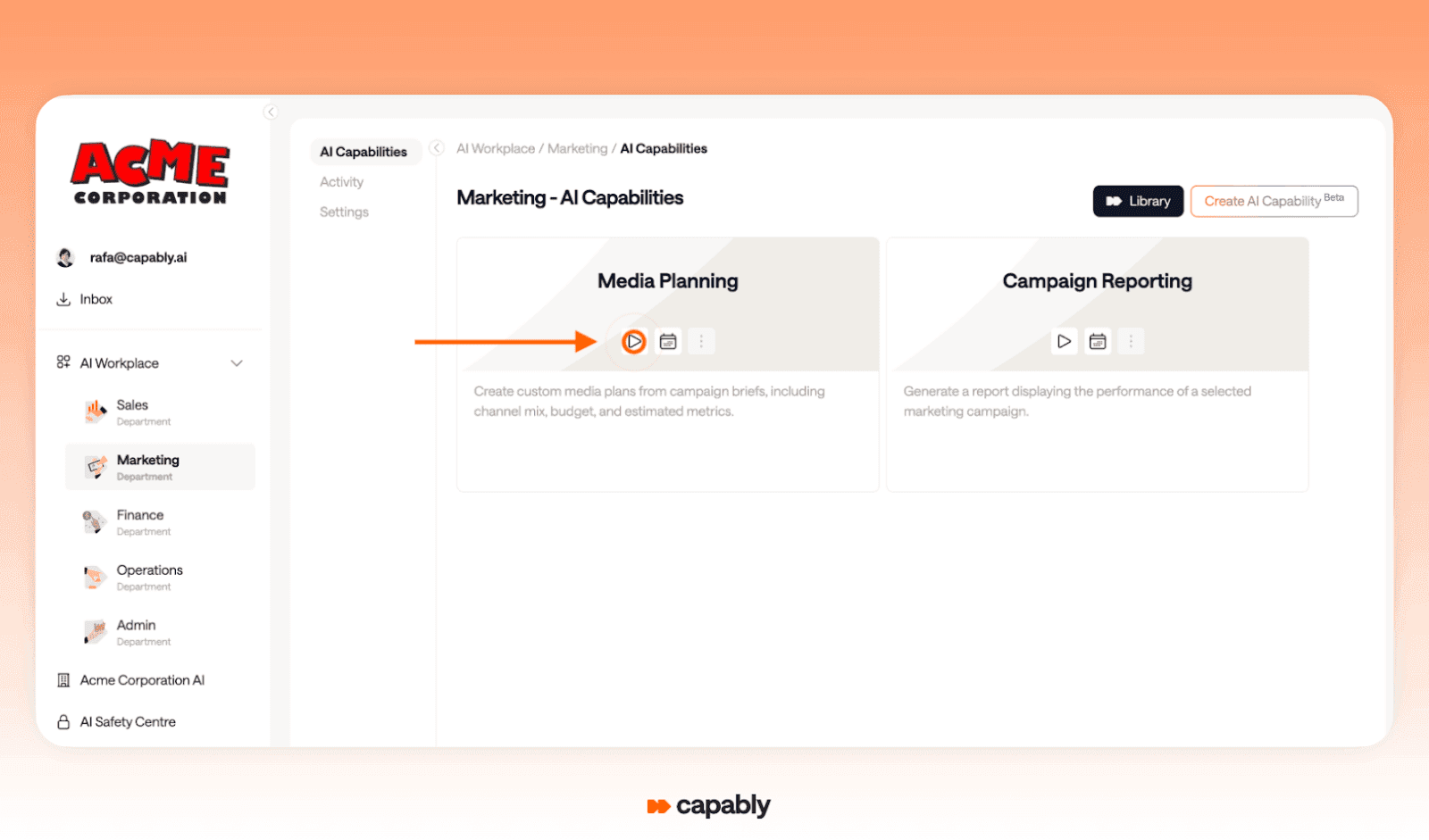
From the Capably dashboard, navigate to the Marketing Library, select the Media Planning workflow, click Add, and then Play. The system prompts only for necessary inputs, while AI agents handle preparation and context behind the scenes.
2—Connect Your Tools
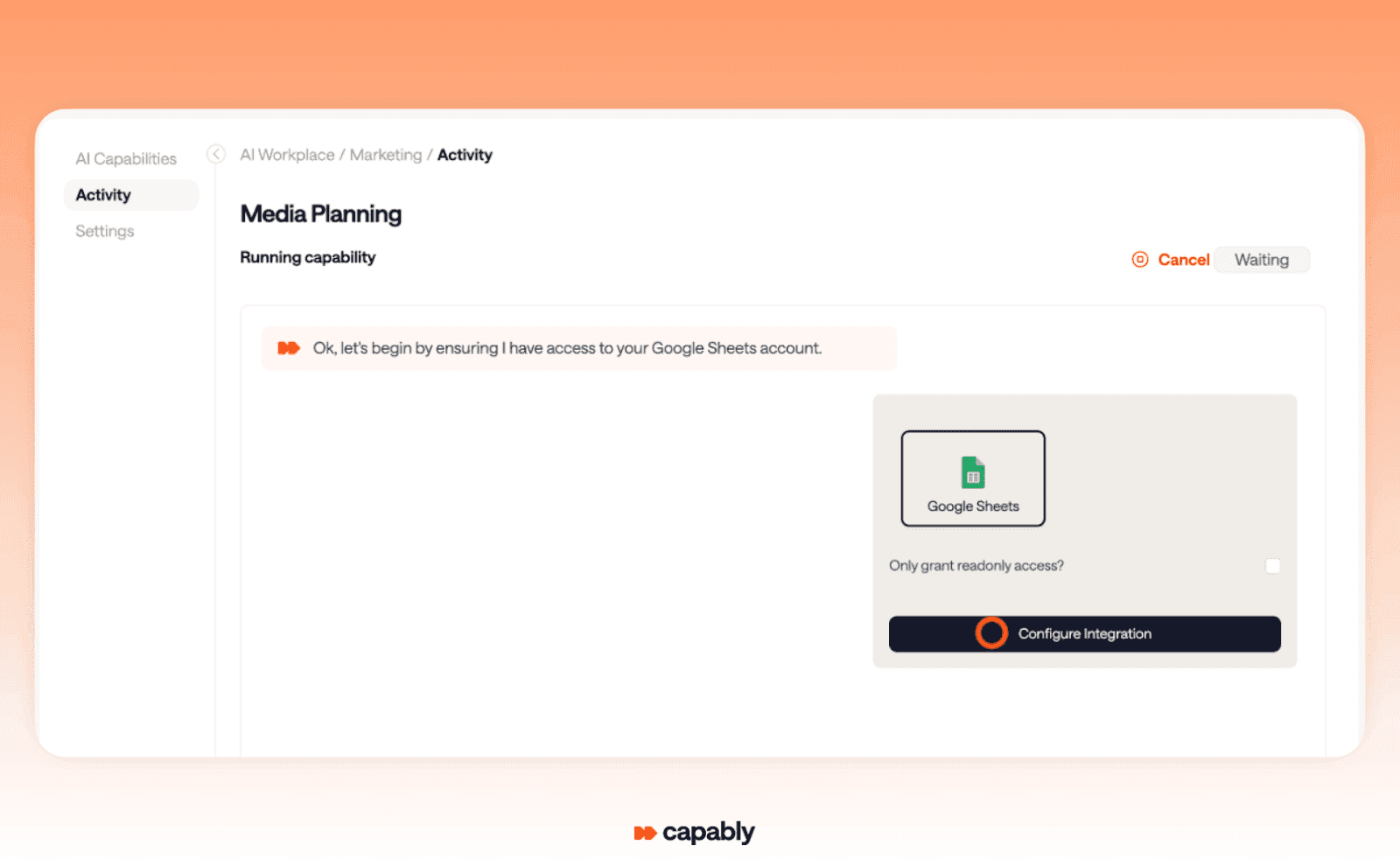
Capably integrates with your existing media planning software, spreadsheets, and other operational tools. Connections are authorized in just a few clicks, eliminating manual syncing and order-entry errors.
3—Submit the Campaign Brief
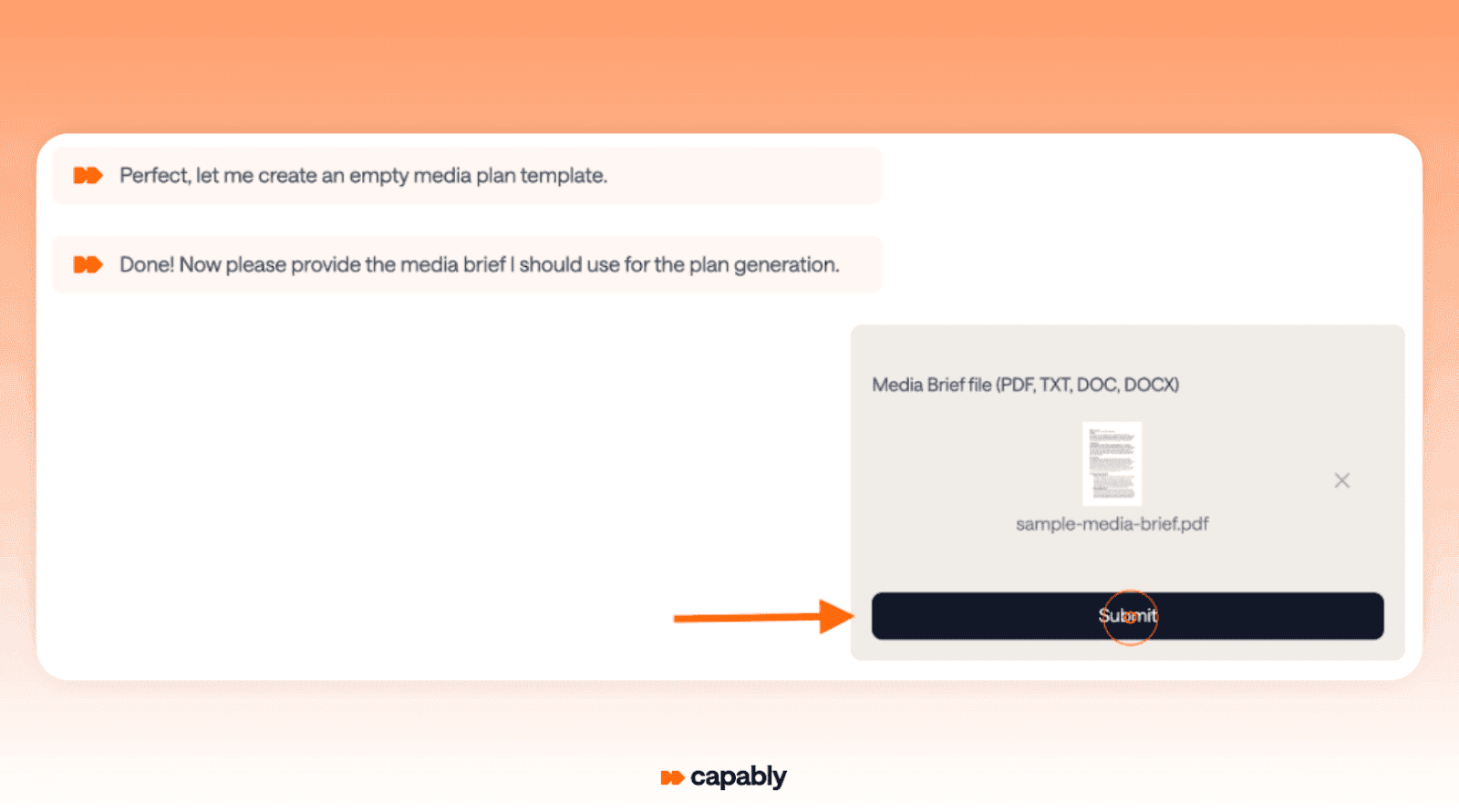
Teams provide a campaign brief including campaign objectives, budgets, and target demographics. Using machine learning algorithms, the platform interprets and structures the data into a ready-to-use media plan. This ensures accurate, consistent input for campaign execution.
4—Review and Approve Inputs
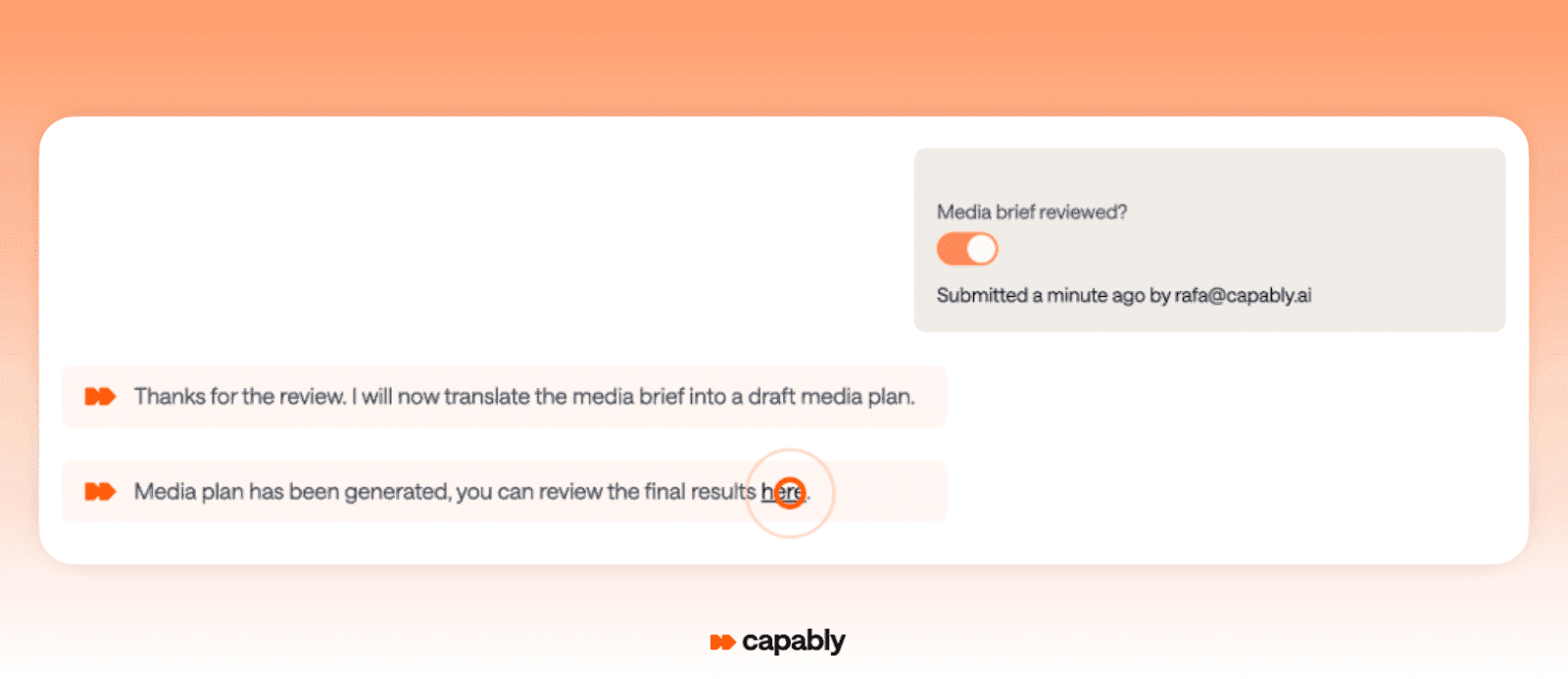
Human oversight remains central. Teams can review interpreted data and make adjustments before the plan is built. This checkpoint ensures strategic alignment, brand safety, and control over creative decisions.
5—Build the Media Plan
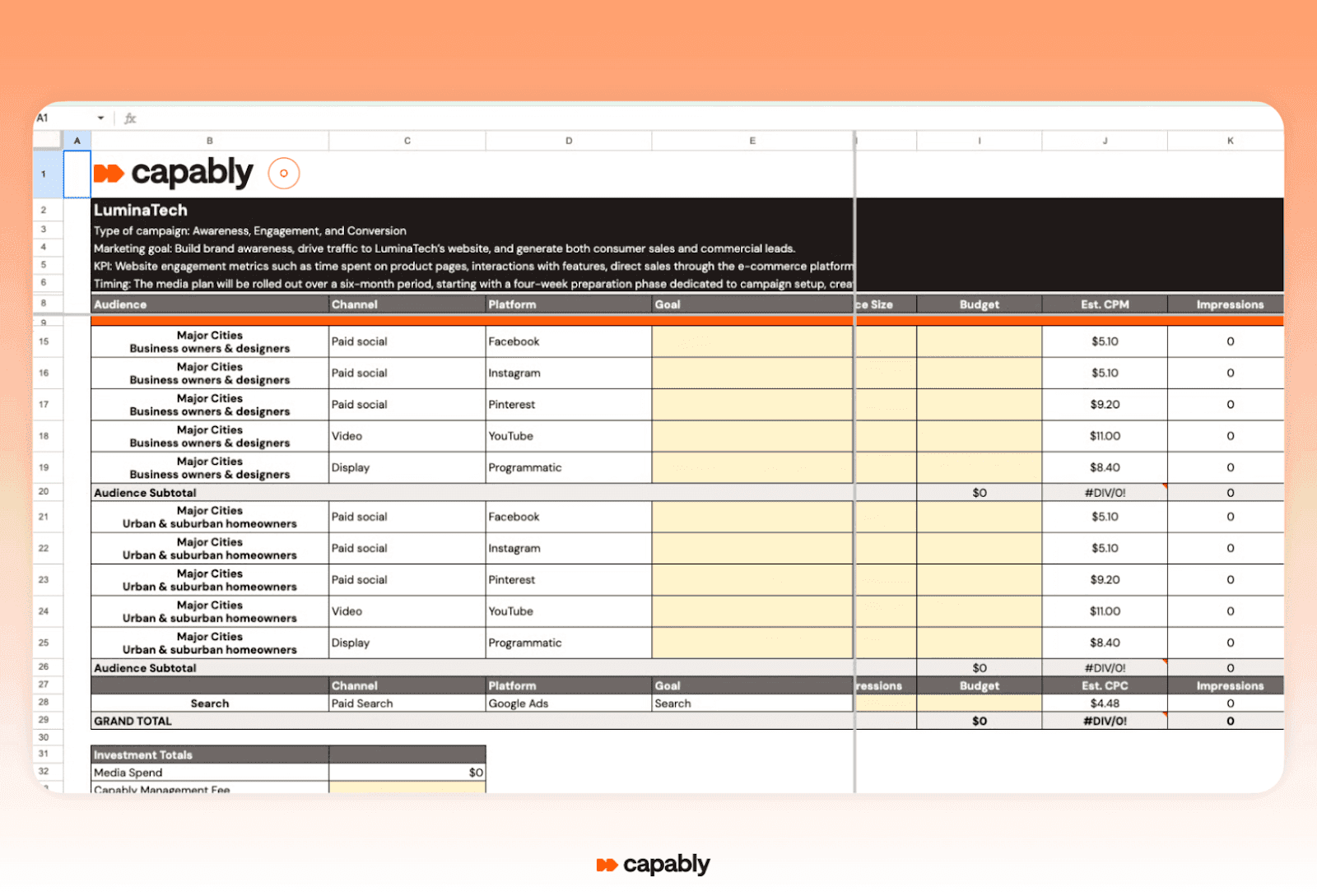
Capably generates a structured plan with recommended media types, ad placements, budget allocations, media orders, and audience targeting. It uses predictive audience segments and actionable insights to guide media buying decisions. This allows creative teams to focus on strategy and ad creatives rather than repetitive tasks.
6—Track, Optimize, and Report
Leadership monitors progress via a custom dashboard. The platform supports campaign tracking, evaluates performance metrics, and flags potential risks, including fraud detection. Recommendations for optimization are provided, while final decisions remain under human control.
Need Something More Specific? Build Your Own
The prebuilt Media Planning workflow works beautifully for many teams—but what if your process is a little more nuanced?
That’s where Capably’s “Create Your Own AI Capability” feature comes in. Using the Describe–Criticise–Automate pattern, you can outline exactly how your team works, and Capably will build custom automation to match. Whether you're integrating multiple media planning software tools, adjusting for regional buying processes, or working across several social media networks, you can tailor the automation without writing code or sacrificing sophistication.
It’s still no code. It’s still agentic AI. But now it’s built exactly around how your business thinks about advertising operations, campaign workflows, and client success.
Strategic and Operational Benefits of Media Planning Automation
Investing in media planning automation is more than a technology upgrade. It is a way to unlock efficiency, improve decision-making, and drive measurable business outcomes. For executives, the value becomes clear across three key dimensions: speed, accuracy, and strategic impact.
1. Faster Execution, Less Manual Overhead
Manual media planning slows response times and drains team capacity. Automation accelerates workflows by handling repetitive tasks such as order entry, campaign setup, and budget allocation (The CMO, 2024).
Decision-makers benefit from shorter planning cycles and faster execution of media campaigns, allowing teams to respond quickly to audience behavior and changes in the buying cycle. With predictable, automated processes, organizations can maintain agility without adding headcount.
2. Improved Accuracy and Reduced Risk
Errors in spreadsheets, disconnected tools, or manual calculations are costly. Automated workflows minimize mistakes, ensure consistency, and support human oversight at critical checkpoints.
Key operational advantages include:
Reliable media planning software integration
Error-free media orders and tracking
Consistent audience segmentation and targeting
Enhanced brand safety and compliance
By reducing operational risk, organizations not only save time but also safeguard campaign performance and reputation.
3. Data-Driven Insights and Strategic Impact
Automation generates actionable insights from performance data in real time (Index.dev, 2025). AI agents and machine learning algorithms analyze performance metrics, monitor audience triggers such as shifts in media consumption, and suggest optimizations for media types and channels. This allows leadership and creative teams to focus on strategy, creative content, and ad creatives, while the system handles repetitive, data-intensive work. Predictive models help target the right audience segments and maximize ROI across campaigns, and improve alignment across the customer journey.
4. Scalability and Flexibility
Cloud-based platforms like Capably allow organizations to scale processes without proportionally increasing headcount. Teams can manage multiple campaigns across diverse media types, integrate with various ad platforms, and customize workflows for unique regional or brand requirements.
This flexibility enables organizations to adapt to changing markets, experiment with new channels, and efficiently support creative swaps or content variations.
5. Client and Business Outcomes
Executives can see the tangible impact on business and client relations:
Faster planning cycles and optimized campaigns improve client satisfaction.
Transparency through a custom dashboard builds trust and demonstrates accountability.
Efficient workflows free up time for strategic thinking, campaign innovation, and stronger ROI.
For medium-sized businesses and agencies, media planning automation is not a luxury. It is a strategic lever that drives better decision-making, more predictable outcomes, and competitive advantage.
Conclusion: Automation That Works the Way Business Does
Media planning has never been short on complexity. What has changed is the tolerance for inefficiency. As expectations rise across speed, accountability, and performance, manual processes increasingly feel like a strategic liability rather than a necessary evil.
Media planning automation offers a practical way forward. When implemented thoughtfully, it brings structure to complexity, consistency to execution, and clarity to decision-making. The goal is not to remove people from the process, but to give them better tools, cleaner data, and more time to focus on strategy, creativity, and results.
Capably demonstrates what this looks like in practice. By combining agentic AI with built-in human oversight, organizations can modernize their workflows without losing control, context, or confidence. Automation becomes a partner in planning rather than a black box running in the background.
For decision-makers, the opportunity is straightforward. Fewer manual bottlenecks. More reliable outcomes. A planning process that scales with ambition instead of slowing it down.
The next step is not to automate everything at once, but to start where it matters most. With the right platform, that first step can be both manageable and transformative.
Continue reading