

For a while, AI in marketing looked almost effortless.
Teams produced more content in less time. Campaign reporting accelerated. Strategy decks came together faster. Creative variations multiplied overnight. Across agencies and in-house departments alike, generative AI quickly became part of everyday work.
The early gains were real.
But in many organizations, progress is slowing. Not because the technology stopped improving. Quite the opposite. AI models are becoming more capable, more accessible, and increasingly embedded in marketing campaigns, content creation, customer engagement, and performance analysis workflows every quarter.
The slowdown is operational.
Many companies are running into what we call the AI marketing plateau: the point where early AI productivity gains stop compounding because the surrounding systems, marketing workflows, and operating structures were never redesigned to scale them.
At first, the benefits feel obvious. Teams save time summarizing web pages, drafting press releases, building presentations, planning campaigns, or developing social strategy. Work that used to take hours can suddenly be completed in a fraction of the time, and it's easy to see why enthusiasm builds so quickly.
The friction usually appears somewhere else.
The organizations getting the most value from AI are no longer focused solely on experimentation. They are increasingly focused on turning isolated wins into enterprise-wide value. Reporting moves faster, but the data still has to be pulled together from multiple places. Different departments adopt different tools and ways of working. None of these issues seems especially serious on its own, yet they create a growing amount of coordination work behind the scenes.
Individual tasks become easier. The broader operation often remains just as complicated as before.
Organizations continue using AI every day, but the business itself does not become meaningfully easier to operate. That is where the AI marketing plateau starts becoming visible, often before leadership teams fully recognize it.
Clients usually notice first.
Capably’s recent research into AI automation maturity across media and advertising organizations clearly reflects this divide. Nearly 59% of surveyed companies reported that no more than a quarter of their workflows are fully automated end-to-end, despite widespread AI adoption across daily operations. Only 37.9% reported building repeatable workflows that extend beyond isolated tasks or experiments.
The pattern is not unique to marketing. Across industries, organizations are adopting AI at a remarkable pace, but many are still figuring out how to turn those early gains into lasting operational improvements. Research from both McKinsey and Deloitte suggests that scaling AI remains significantly harder than implementing it in the first place (McKinsey & Company, 2025; Deloitte, 2025).
The companies making the most progress aren't always the ones talking about AI the most. In many cases, they've simply done the less visible work that makes automation easier to scale. Teams follow more consistent processes. Information moves more cleanly between systems. When a workflow works, other teams can adopt it without having to start from scratch.
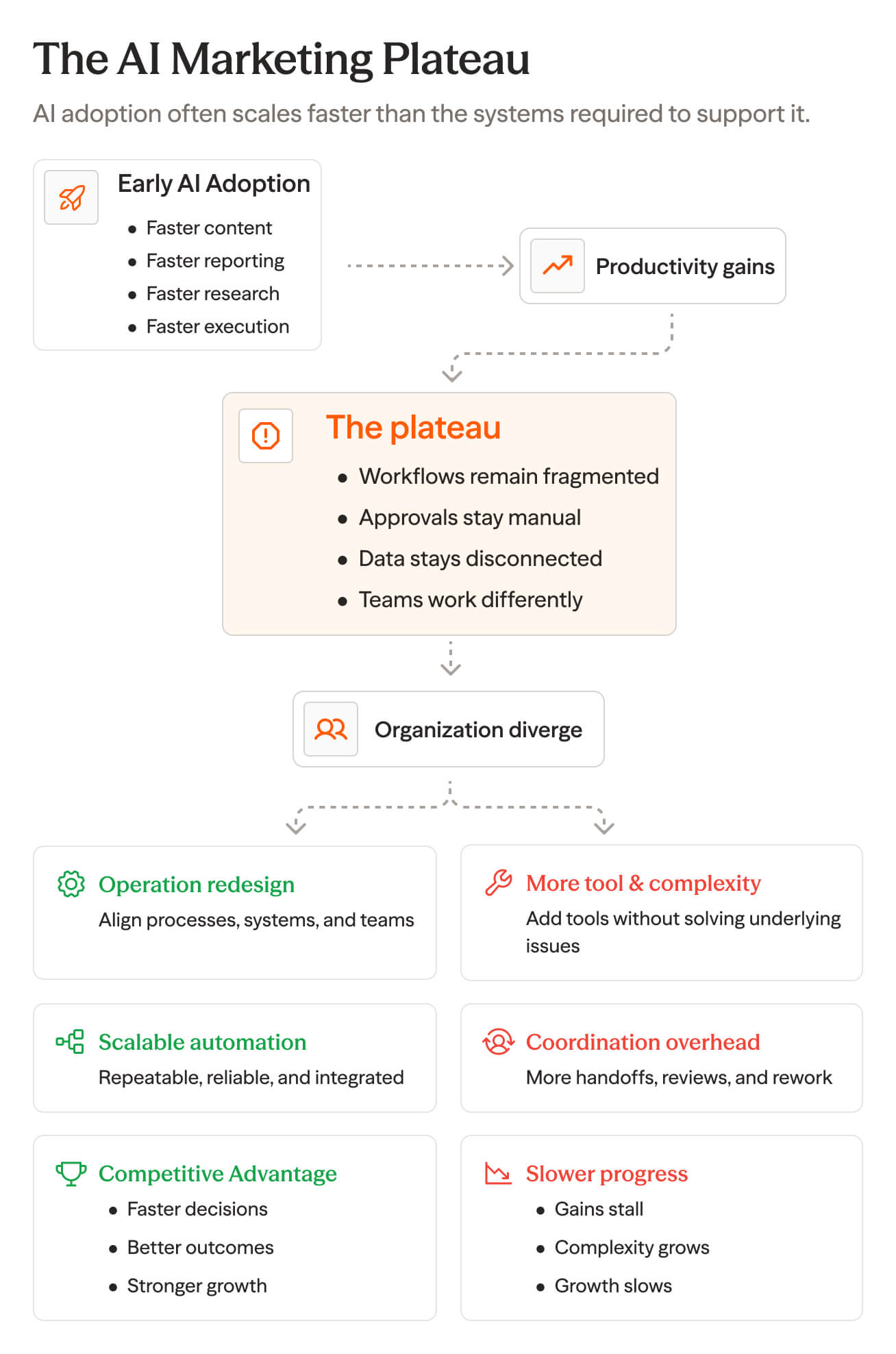
The next phase of competitive advantage will likely belong less to companies that use AI and more to companies that operationalize it.
Early AI Wins Are Easy to Mistake for Digital Transformation
One reason the AI marketing plateau catches organizations off guard is simple: the early wins arrive fast enough to feel transformational.
And to be fair, some of them genuinely are.
Generative AI does not behave like most enterprise software rollouts. Teams do not wait six months to feel the impact. A strategist cuts a morning of research down to twenty minutes, making content strategy decisions faster than before. Somebody in creative walks into a kickoff already holding three campaign directions. Reporting that used to drag through the afternoon suddenly gets finished before lunch.
The shift feels obvious almost immediately, and that changes expectations inside the business faster than many leadership teams anticipate.
When work starts moving this quickly, people naturally assume the organization itself is becoming more advanced. Often it is not. In many companies, the same approval chains, reporting habits, and fragmented workflows still sit beneath the new AI layer. They just become easier to overlook as productivity continues to improve.
At first, very little feels broken. Campaigns move faster, content marketing becomes easier to scale, and teams find dozens of small ways to save time throughout the week. The gains are noticeable enough that most people focus on what is improving rather than what has stayed the same.
The problems tend to show up later and rarely all at once. A report still needs someone to clean up the numbers before it goes out. Two teams solve the same problem using completely different tools. An AI-generated insight looks convincing until someone spots an error. Most AI errors are caught before they cause serious damage, but they still create additional review work. None of these moments is a crisis on its own, but together they create more coordination work than anyone expected.
Individually, none of these problems looks especially dramatic.
That is partly why the AI marketing plateau is easy to miss early. The organization is still becoming more productive overall, but underneath that progress, operational drag is starting to accumulate. Teams spend more time managing inconsistencies across systems, workflows, and outputs that were never really designed to operate together at this speed.
Other industries have already gone through versions of this. Contact centers, supply chain operations, and large-scale business automation environments have all discovered something similar: isolated automation tends to scale much faster than operational coordination.
Over time, productivity can begin to mask the automation debt accumulating beneath those workflows.
That is usually the point where the AI marketing plateau becomes far more difficult to resolve than most organizations expect.
The Companies Pulling Ahead Are Redesigning Operations, Not Just Adding AI
Some organizations are already moving beyond the AI marketing plateau, and what separates them is usually operational discipline.
The companies seeing the strongest long-term gains from generative AI are often the ones paying close attention to how work actually moves through the business once the excitement around automation settles down. In many cases, they are less experimental than their competitors, just more structured in how execution scales across teams.
Briefing systems stay consistent. Reporting logic is easier to follow. Workflows do not need to be rebuilt every quarter because somebody changed platforms or prompting methods midway through delivery.
None of this sounds especially revolutionary, but operationally, it changes a great deal.
A creative department might generate excellent outputs using multiple AI models, yet still lose most of the efficiency gains if campaign assets require heavy manual restructuring before launch. A performance unit may accelerate optimization dramatically while still struggling to improve conversion rates, reconcile customer data, slow reporting, and an inconsistent customer experience across channels.
Over time, the bottleneck shifts from execution itself to the coordination surrounding it.
Capably’s research reflects this clearly. Agencies with higher levels of automation were far more likely to report that successful workflows expanded smoothly across teams. Among the highest-automation organizations, nearly 88% reported that expanding workflows was relatively easy. In lower-maturity organizations, that number dropped sharply.
The findings point to something bigger than marketing. The organizations getting the most value from AI are no longer focused solely on experimentation. They are spending more time figuring out how to reuse, maintain, and expand successful workflows across the business. Deloitte's research points to a similar trend, with organizations finding that scaling AI depends as much on operational discipline as it does on the technology itself (Deloitte, 2025).
The technology still matters. The operating environment matters more.
AI tends to magnify whatever conditions already exist inside the business. Teams with relatively stable operating structures usually scale automation more smoothly because their underlying systems are well coordinated enough to absorb additional complexity. Organizations built around fragmented processes often experience the opposite effect. More automation creates more exceptions, more approvals, more reconciliation work, and eventually more operational noise than teams expected to manage.
That is where many AI initiatives begin to lose momentum, not during experimentation but at scale.
The pressure to ignore it grows as companies move toward more advanced agentic systems and agentic process automation environments. Once automation starts coordinating actions across planning, reporting, optimization, and execution, weak governance structures and disconnected feedback loops no longer sit quietly in the background. Automation exposes those inconsistencies continuously.
The organizations pulling ahead are not removing people from the workflow. They are redesigning how people, systems, and automation operate together before coordination costs start compounding faster than the business can absorb them.
Why the AI Marketing Plateau Becomes a Leadership Problem
Most organizations do not run into the AI marketing plateau because the technology suddenly stops working.
Usually, the problems start somewhere much less dramatic.
The warning signs usually appear in much smaller ways. A reporting process that was supposed to become easier still requires hours of manual cleanup. One team adopts a new AI workflow while another solves the same problem differently. Approval cycles that felt manageable six months ago suddenly struggle to keep up with the volume of work being produced.
None of these issues seems particularly serious on its own. In conversations with marketing leaders, this is often the stage where frustration begins to replace enthusiasm, even as AI adoption continues to grow. The problem is that they tend to accumulate quietly until a missed deadline, a conflicting report, or a breakdown in delivery forces people to pay attention.
From the outside, that slowdown is often mistaken for a technology problem. If the first wave of automation created clear gains, it seems reasonable to assume the next wave will do the same. Organizations respond by adding more tools, expanding licenses, or introducing AI into additional departments.
Sometimes that helps.
But often, new technology ends up amplifying weaknesses that already existed within the operating model.
Creative teams can produce assets faster than they can review them. Performance specialists spend less time generating reports but more time reconciling inconsistent data. Strategy teams uncover insights more quickly, yet still struggle to translate them into coordinated action across the business.
Meanwhile, departments quietly start building their own ways of working around the technology.
Different prompting habits. Different reporting standards. Different automation logic. Small process decisions are made independently, gradually making the organization harder to coordinate as a whole.
The business keeps accelerating. The operating structure underneath it does not.
That is usually where the AI marketing plateau starts turning into a leadership problem rather than a workflow problem.
Because eventually the conversation changes. The challenge is no longer whether teams can use generative AI effectively. Most already can. The harder question is whether the organization has enough operational structure to scale automation without creating new friction elsewhere in the business.
That shift tends to force less glamorous conversations inside leadership teams.
Not:
How much more content creation can we automate?
Which AI-powered platforms should we test next?
Which departments are adopting artificial intelligence fastest?
Instead:
Which workflows actually need standardization?
Where are approvals unnecessarily slowing down delivery?
Which decisions still require human judgment?
What operational trade-offs are we creating while trying to scale faster?
Those discussions are less exciting than new technology announcements.
They are also usually the ones that determine whether automation improves the business over time or simply makes complexity harder to manage at a higher speed.
Fragmented automation starts creating costs that are easy to miss at first. Marketing teams spend more time coordinating campaigns across channels than they expected. Data that should tell a single story begins producing conflicting signals depending on which system someone looks at. Small workarounds emerge across teams and gradually become part of the process. Before long, people find themselves repeating work that was supposed to be automated simply because information is no longer moving cleanly through the organization.
Most organizations do not notice the shift immediately.
At first, it just feels like more coordination work than expected.
Then margins tighten. Delivery consistency becomes harder to maintain. Teams spend an increasing amount of time fixing exceptions, reconciling systems, and manually correcting workflows that were originally intended to reduce operational drag. By that stage, the automation debt has usually spread beyond individual workflows into the operating model itself.
The irony is difficult to miss.
Many organizations already have sufficient AI capability to transform large parts of their businesses. What they often lack is the strategic clarity, operational discipline, and AI literacy required to turn those isolated efficiency gains into something that actually scales.
What Higher-Maturity Organizations Are Starting to Figure Out
The companies moving beyond the AI marketing plateau are not necessarily automating more.
In many cases, they are automating less than people expect.
Just more deliberately.
That tends to surprise organizations still deep in experimentation mode, where maturity is often measured by how many workflows can be automated at once. Companies that scale successfully usually approach the problem differently. They become more selective about where automation genuinely creates leverage and where it instead adds operational friction.
Not every workflow benefits from automation in the same way.
Companies that move beyond the AI marketing plateau usually become more selective about where AI creates leverage. Tasks built around stable inputs—reporting, CRM updates, performance monitoring, or audience segmentation—often scale well because the decisions involved are relatively predictable. The gains are visible quickly, and the workflows are easier to standardize.
The limitations tend to appear when organizations try to apply the same approach to work that depends heavily on context, judgment, or relationships. Generating a first draft of a report is one thing. Deciding whether a campaign idea is right for a particular client is something else. The output may arrive faster, but teams often spend more time reviewing, refining, and validating the result.
That experience changes how higher-maturity organizations think about automation. Instead of trying to automate everything possible, they become more deliberate about where automation genuinely improves the process.
The question shifts from "Can this be automated?" to "Will automation actually make this process work better?"
In practice, that often leads to fairly unglamorous work. Teams revisit briefing processes. They clean up data that nobody fully trusted in the first place. They simplify approval chains that had gradually become more complicated than necessary. None of those projects generates much excitement, but they often have a bigger impact on scalability than adding another AI-native tool to the stack.
A fragmented reporting process does not become less fragmented because AI is added to it. In some cases, the underlying problems simply become more visible as work starts moving faster.
For a while, teams can work around the gaps. Someone fixes a report before it reaches the client. Another person checks outputs before they go live. A spreadsheet appears to bridge two systems that don't quite connect. None of it feels particularly urgent. Over time, those small fixes start piling up. Work is getting done faster than before, yet people seem busier. The gains are real, but so is the extra coordination required to keep everything running smoothly.
The question is whether the organization can remain coherent as everything around it accelerates.
Operational Coherence Is Becoming the Real Competitive Advantage
For the past two years, most AI conversations in marketing have focused on capabilities. Which AI models produce the strongest outputs? Which platforms automate the most tasks? Which teams adopt the fastest?
Those questions still matter. They just explain the competitive gap less than they used to.
As generative AI becomes more accessible across the market, adoption alone becomes a less significant differentiator. Most agencies and marketing organizations already use similar AI-powered platforms, similar content creation systems, and increasingly similar automation tools. The technology advantage narrows quickly once everyone is working from a roughly similar foundation.
What actually starts separating organizations is how well the surrounding systems function.
The companies moving beyond the AI marketing plateau are usually building environments where automation compounds rather than fragments. Performance data moves more reliably between planning, execution, reporting, and optimization systems. Feedback loops tighten because teams spend less time manually reconnecting workflows that were never designed to operate cleanly together in the first place.
That matters more as marketing ecosystems become harder to coordinate.
Modern marketing campaigns now span paid media, creator ecosystems, commerce integrations, customer engagement platforms, and multi-modal campaigns while generating thousands of daily customer interactions across fragmented channels. The amount of unstructured data moving through those environments continues growing faster than most organizations can realistically manage through manual coordination alone.
At first, the pressure rarely looks serious. Teams compensate. Additional approvals appear. Workarounds emerge quietly inside departments.
Then complexity starts compounding faster than coordination can keep up.
The difference becomes more obvious as automation spreads. In some organizations, new workflows slot into place without causing much disruption. In others, each new automation seems to create a fresh set of issues to solve. Teams spend more time checking outputs, fixing handoffs between systems, and dealing with unexpected exceptions.
The issue is rarely a lack of artificial intelligence capability. Most organizations already possess enough technical capability to automate large portions of their marketing operations.
The harder question is whether the business itself can remain operationally coherent as scale, speed, and complexity accelerate simultaneously.
The AI Marketing Plateau Will Likely Widen Before It Improves
One of the more important implications of the AI marketing plateau is that the gap between organizations may become harder to close over time.
Not because some companies suddenly gain access to dramatically better technology. Most agencies and marketing organizations are already working with similar AI models, similar automation capabilities, and increasingly similar AI-powered platforms.
The difference begins to emerge in how well the business itself absorbs automation as complexity increases.
Organizations with cleaner systems, stronger governance, more stable data infrastructure, and clearer operating design usually scale successful workflows faster once automation expands across the business. Coordination improves. Delivery becomes more consistent. Teams spend less time correcting avoidable operational friction and more time optimizing performance.
Companies operating through fragmented environments often experience the opposite pattern. More automation creates more reconciliation work, more exceptions, more manual correction, and eventually more coordination overhead than teams expected to manage.
At first, the gap can look relatively small.
A slower reporting cycle. Extra approval friction. Inconsistent delivery across channels.
Then, clients start noticing the difference.
Some organizations adapt smoothly as complexity increases. Others begin slowing down under the operational weight of the systems they built around the technology.
That is why the next phase of AI adoption will likely reward companies that integrate automation effectively into day-to-day operations, not simply those that generate more outputs faster.
The organizations most likely to move beyond the AI marketing plateau will probably not be the ones automating the most aggressively. More often, they will be the ones disciplined enough to simplify workflows before scaling them, standardize systems before expanding them, and avoid accumulating automation debt faster than the business can absorb it.
Over time, the advantage created by AI may depend less on the technology itself and more on whether the organization around it can still operate coherently as everything accelerates.
For agencies already feeling those operational pressures, breaking through the plateau usually requires more than adding another tool. It often requires stepping back, assessing their AI maturity, and redesigning how workflows, systems, automation, and teams operate together at scale. That is increasingly where the competitive gap is being created.
References
Capably. (2026). The State of AI in the Media and Advertising Industry.
Deloitte. (2025). State of generative AI in the enterprise: Scaling AI for operational transformation. Deloitte Insights.
McKinsey & Company. (2025). The state of AI: How organizations are rewiring to capture value. McKinsey & Company.
Continue reading