

Over the past year, I’ve had dozens of conversations with agency leaders about AI.
What has surprised me most is not how often AI comes up. It’s how similar the conversations have become.
Teams are generating content faster. Reporting cycles that once took hours now take minutes. Research, analysis, and campaign planning all move more quickly than they did a year ago. Most agencies can point to tangible productivity gains, and many are genuinely happy with the results they’re seeing.
Yet when the conversation shifts from individual wins to organizational readiness and operational change, the picture becomes less clear.
The same agencies that are seeing benefits from new AI capabilities often describe familiar challenges beneath the surface. Work still gets stuck between teams. Processes remain difficult to scale. Successful AI initiatives remain confined to individual departments rather than spreading across the organization.
In other words, AI is making people faster without necessarily making the business operate differently.
Similar patterns have been observed in broader enterprise AI research. While organizations are reporting meaningful productivity gains from AI adoption, many continue to struggle to translate those gains into wider operational change (McKinsey & Company, 2024; Deloitte, 2025).
That tension sits at the center of where the industry finds itself today.
In our recent study of 62 media, advertising, and in-house marketing leaders, nearly 60% reported that no more than a quarter of their workflows are automated end-to-end (Capably, 2025). At the same time, AI adoption is widespread, satisfaction levels are generally positive, and most respondents expect AI to have a significant impact on agency operations over the next few years (Capably, 2025).
The gap isn't access to AI. It's what agencies do with it.
Some agencies are using artificial intelligence primarily to accelerate individual tasks. Others have started building repeatable workflows around AI. A smaller group has gone further, embedding automation into the way work moves across teams, services, and client delivery.
Those organizations may use many of the same tools, foundation models, and generative AI platforms. What separates them is the degree to which automation is integrated into the operating model.
Put differently, some agencies are layering AI onto existing processes. Others are redesigning processes around it.
That distinction matters because AI maturity has become a better predictor of long-term advantage than AI adoption alone.
So before investing in another platform, experimenting with new AI agents, or expanding your AI strategy, it’s worth answering a simpler question:
How mature is your agency’s approach to AI today, and what does that say about your AI readiness? This AI maturity model for agencies is designed to help answer that question.
The next few minutes should give you a clear answer.
Which Stage Are You In?
Most agencies already have at least a few successful AI use cases.
The harder challenge is figuring out where they actually stand.
A lot of agencies judge their AI progress by how many tools they've rolled out or how many people are using them. The problem is that usage and maturity aren't the same thing. An agency can have ChatGPT, Claude, Gemini, and half a dozen other AI tools in daily use while the underlying work still moves exactly as it did a year ago.
A better test of organizational readiness is to look at how work gets done. Does AI primarily help individuals work faster? Does it support repeatable workflows? Or has it become part of the operating model itself?
The three stages below form a practical AI maturity model for agencies based on the patterns we observed across media, advertising, and in-house teams. Read through them and identify the description that feels most familiar. Think of this as a practical AI maturity assessment rather than a theoretical framework.
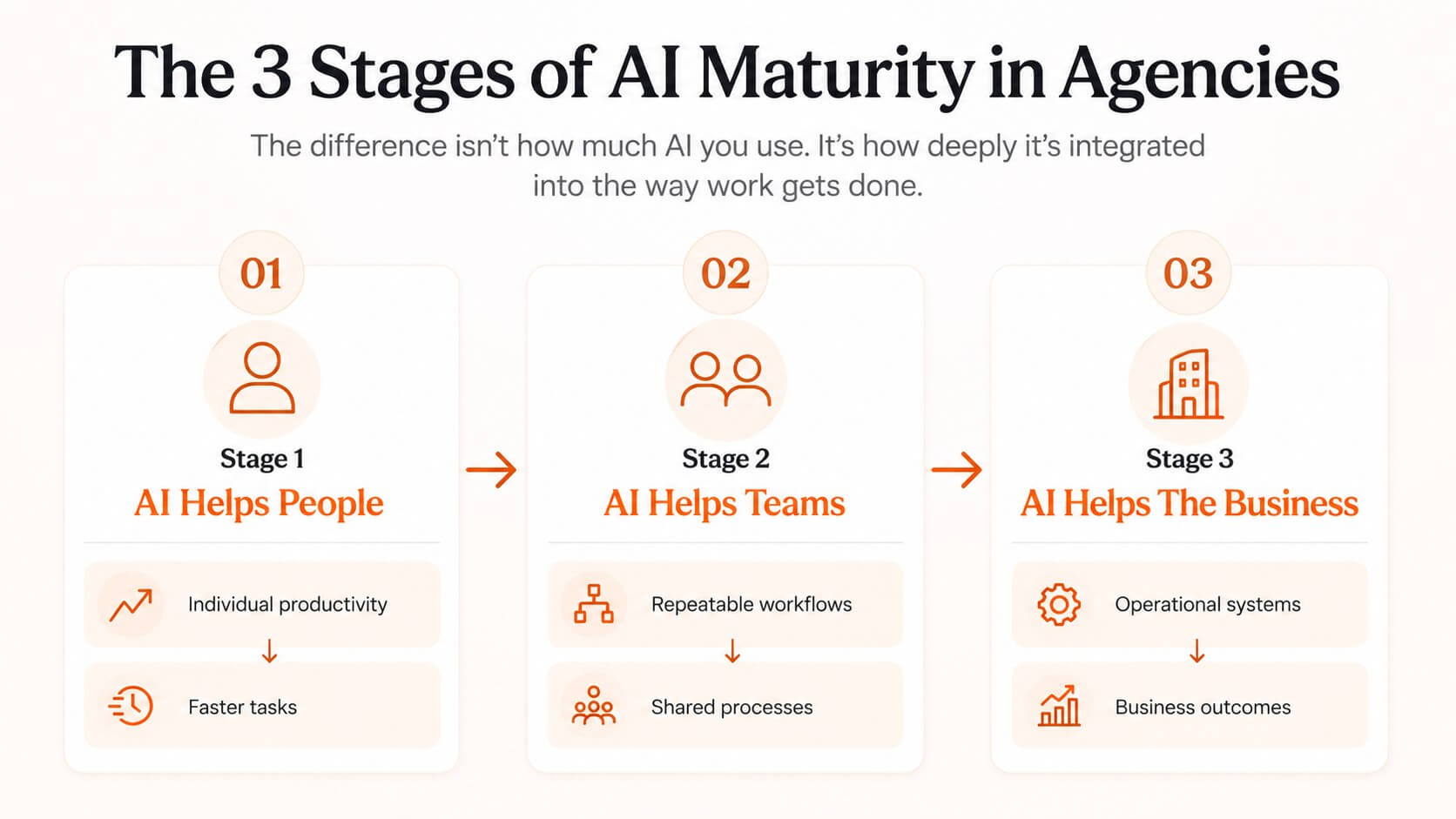
Stage 1: AI Helps People
Formal maturity stage: Tool-Level Adoption
Most agencies reading this will probably recognize the pattern.
AI has become part of day-to-day work. Teams use it regularly, and many can point to clear productivity gains. Ask around the agency, and you'll hear plenty of examples of time saved, faster turnaround times, and better output.
What's changed is how quickly people work. What's usually unchanged is how the work itself moves through the business. Projects still rely on the same handoffs, approvals, and coordination between teams. AI is helping people operate within the system rather than changing the system itself.
That's why many of the biggest wins remain difficult to scale. They often depend on the initiative of a particular team or individual rather than a workflow that the rest of the agency can easily adopt.
This probably sounds familiar:
✓ Team members have their own prompts, tools, and ways of working
✓ AI is used regularly across the agency
✓ Most AI success stories are team-specific or individual
✓ Work still relies heavily on manual coordination
✓ Automation rarely spans multiple departments
✓ AI saves time, but scaling those wins remains difficult
If four or more apply, you’re likely operating at Stage 1.
Stage 2: AI Helps Teams
Formal maturity stage: Workflow-Level Integration
This is usually the point where agencies stop experimenting and start building repeatable ways of working.
Certain activities become repeatable and more structured. Campaign reporting, content production, campaign analysis, audience research, or other recurring processes start incorporating automation in ways that can be reused by multiple people. Teams no longer rely solely on individual expertise because successful workflows are being documented, shared, and repeated.
The benefits are real, but so are the growing pains. As teams start reusing successful workflows, differences in how people work become harder to ignore. A process that works well in one team often needs adjustments before another team can use it successfully.
This probably sounds familiar:
✓ Repeatable AI workflows exist within teams
✓ Some processes run partially end-to-end
✓ Teams reuse successful automations
✓ AI contributes directly to delivery outcomes
✓ Certain workflows scale successfully
✓ Expanding automation still requires significant coordination
If four or more apply, you’re likely operating at Stage 2.
Stage 3: AI Helps the Business
Formal maturity stage: System-Level Institutionalization
By this point, automation is no longer confined to individual tools or isolated workflows. It becomes part of how the organization operates.
Workflows are designed with automation in mind from the outset. Ownership is clear. Processes are standardized. Successful systems can be expanded across teams without requiring extensive rework. AI initiatives are increasingly linked to delivery performance, operational efficiency, revenue generation, or client outcomes.
Interestingly, agencies at this stage often use many of the same tools as everyone else. The difference isn't the technology. It's how deeply automation has been built into the way work gets done.
This probably sounds familiar:
✓ Automation spans multiple teams or departments
✓ Ownership and accountability are clearly defined
✓ Successful workflows can be replicated easily
✓ AI initiatives are linked to business outcomes
✓ Governance and performance tracking are established
✓ Teams spend more time overseeing systems than performing repetitive execution
If four or more apply, you’re likely operating at Stage 3.
Most leaders can identify their stage fairly quickly. The harder question is why progress often slows down once they get there.
The difference was whether successful experiments became repeatable systems or remained isolated wins.
That's where agencies tend to stall. It's also where the biggest opportunities tend to be hiding.
Why Agencies Get Stuck
One of the more surprising findings from our research was that the biggest barriers to progress were rarely technological (Capably, 2025).
Very few respondents believed the technology itself was the problem. Instead, the obstacles tended to appear in workflow design, coordination, ownership, and implementation—similar to challenges reported in broader enterprise AI initiatives. In other words, agencies were usually slowed down by operational challenges rather than AI capabilities.
The pattern also changed as agencies matured. The problems that keep an agency in Stage 1 are not the same ones that prevent a Stage 2 agency from progressing further.
Why Agencies Get Stuck in Stage 1
The biggest misconception at this stage is that a stronger AI strategy starts with more tools.
Most agencies at this stage can point to what is working. Reporting takes less time. Research gets done faster. Content moves through production more quickly, and response time improves across many routine tasks. Many of these early wins come from generative AI tools used by individual team members. The frustration is that those wins rarely spread very far. What works well for one team often stays with that team.
The sticking points were much more practical: figuring out where automation genuinely belonged, deciding what was worth automating, and maintaining workflows once the excitement of the initial experiment wore off.
The result is a familiar pattern: lots of activity, scattered wins, and very little operational change.
Why Agencies Stall in Stage 2
Stage 2 introduces a different problem.
At this maturity level, the challenge is no longer proving that AI works. It’s making successful workflows work consistently across the organization.
This is usually where hidden differences between teams begin to surface. One team documents processes carefully. Another relies on tribal knowledge. One group follows a standard briefing process. Another has its own approach. Those differences may not matter much when people are doing the work manually. They matter a great deal when you're trying to scale automation.
Progress often slows at this point. Agencies have workflows that work, but they struggle to make them part of the wider business. What succeeds in one team doesn't automatically spread to five others.
Ownership is usually part of the problem. Someone built the workflow, but nobody is clearly responsible for maintaining it, documenting it, or helping other teams adopt it. In many cases, gaps in AI literacy make that process even harder. As a result, good ideas stay local.
The encouraging part is that neither of these problems requires a breakthrough in AI technology.
There are operational problems.
And operational problems can be fixed.
The question is where leaders should focus their attention first.
The One Thing To Focus On Next
AI maturity discussions often become more complicated than they need to be. Before long, you're looking at AI roadmaps, governance frameworks, and endless lists of recommendations.
In reality, the next step is usually much simpler. Agencies tend to progress when they solve the constraint directly in front of them rather than trying to fix everything at once.
That's the purpose of this AI maturity model for agencies: helping leaders identify the next practical step rather than chasing every new AI trend.
If You're in Stage 1, Build One Repeatable Workflow
Most Stage 1 agencies don't have a technology problem. They already have access to capable tools and plenty of examples of AI delivering value.
Instead of asking where else AI could help, pick one process that occurs frequently, follows a predictable pattern, and takes longer than it should. Then focus on making it work consistently.
Reporting is often a good place to start. Content production, audience research, and campaign QA can work too. The important thing is choosing a process that happens regularly and getting it to a point where other people can use it successfully.
Until that happens, AI remains a collection of useful experiments.
If You're in Stage 2, Standardize Before You Scale
This is where many agencies get ahead of themselves.
A workflow works for one team, so the instinct is to roll it out everywhere. Then adoption stalls, exceptions pile up, and people quietly return to old habits.
The problem is rarely the workflow itself.
More often than not, teams are working from different assumptions, processes, and inputs. Automation exposes those differences because systems depend on consistency in ways that people often don't.
Before expanding automation further, focus on making successful workflows easier for other teams to adopt. The agencies that progress tend to make work more consistent before trying to automate it.
Most agencies at this stage don't need more automation.
They need fewer exceptions.
If You're in Stage 3, Focus on Governance and Optimization
At Stage 3, the challenge changes again.
The question is no longer whether automation works or whether it can scale. This is the stage where AI governance becomes increasingly important. The focus shifts to reliability, quality, and performance over time. As workflows become more sophisticated, agentic AI systems and AI agents often take on a larger role in execution and coordination.
At this stage, small problems tend to become much more visible. Issues with data quality, inconsistent outputs, or workflow design that once seemed minor can quickly become operational challenges. A workflow that occasionally produces inconsistent results might not matter when one team is using it. It matters a lot more when multiple teams depend on it every day.
The agencies that continue progressing spend less time looking for the next thing to automate and more time improving reliability, reducing risk, and strengthening the workflows they already rely on.
The goal is not more automation. It’s better automation.
Notice that none of these priorities depend on a breakthrough in AI technology. They're operational decisions. And that's exactly what makes them achievable.
The Real Divide Isn't AI Adoption
As agentic AI becomes more common across agencies, the question is no longer whether artificial intelligence belongs in the business. The more important question is how deeply it has been integrated into the way work gets done.
The agencies pulling ahead are not necessarily using different tools from everyone else. In many cases, they're working with the same platforms, the same foundation models, and access to the same AI capabilities. What defines their maturity level is their ability to turn isolated successes into standard ways of working across the business.
One thing that stood out in the research is how differently agencies can experience AI, even when using many of the same tools. On the surface, they may look similar. Underneath, the way work gets done can be completely different.
In my experience, the challenge usually isn't getting people to try AI. Most agencies have already crossed that hurdle. The harder part comes later, when a workflow works well for one team, and the business has to decide whether it stays a useful shortcut or becomes part of how everyone works.
If you've worked through this AI maturity model for agencies, you should now have a clearer sense of where your agency stands and what deserves attention next in your AI strategy. Whether you're building your first repeatable workflow or trying to scale automation across the business, progress usually comes from solving the next problem in front of you rather than trying to transform everything at once. The goal is steady progress toward the next stage of maturity.
If you'd like help interpreting the results of your AI maturity assessment, or simply want an outside perspective on where your agency sits today, or what the next practical step should be, feel free to reach out. These are exactly the kinds of conversations we have with agency leaders every day.
Frequently Asked Questions
What is an AI maturity model for agencies?
An AI maturity model helps agencies understand where they are in their AI journey. The goal isn't to count tools or track usage. It's to understand how deeply AI has been integrated into the way work gets done, from individual tasks through to workflows, teams, and business operations.
What is the difference between AI adoption and AI maturity?
AI adoption tells you whether people are using AI. AI maturity tells you how much that usage has changed the way the agency operates. An agency can have AI tools in daily use across multiple teams while still relying on the same processes, approvals, and ways of working it had before. That's why adoption and maturity are not always the same thing.
How can agencies assess their AI maturity?
The simplest way to assess AI maturity is to examine how work gets done across the organization. If AI primarily helps individuals work faster, the agency is likely in an early stage of maturity. If AI supports repeatable workflows across teams or is embedded in business operations, the agency is likely operating at a higher maturity level.
What are the stages of AI maturity in agencies?
This article outlines three stages:
Stage 1: AI Helps People – AI improves individual productivity but has a limited impact on how work moves through the business.
Stage 2: AI Helps Teams – Repeatable workflows emerge, and successful automations begin to scale across teams.
Stage 3: AI Helps the Business – Automation becomes part of the operating model and is linked to broader business outcomes.
Why do agencies get stuck in AI adoption?
Most agencies do not get stuck because of the technology itself. The biggest barriers are usually operational. Common challenges include workflow design, ownership, process consistency, AI literacy, and the ability to scale successful experiments across the organization.
What should agencies focus on after completing an AI maturity assessment?
The next step depends on the agency's current stage. Agencies in Stage 1 should focus on building one repeatable workflow. Agencies in Stage 2 should focus on standardizing successful processes before scaling them. Agencies in Stage 3 should focus on AI governance, optimization, reliability, and continuous improvement.
Continue reading