AI Strategy & Adoption
AI in Advertising Agencies: From Tools to Systems (A Maturity Framework)

AI Adoption Isn’t the Competitive Advantage Anymore
For the past two years, the conversation around AI in advertising agencies has centered on adoption. Which tools teams are using. How quickly content production can happen. Whether generative AI can accelerate campaign execution, reporting, media planning, or creative development.
That phase is largely over.
Most agencies already use AI in some form. According to McKinsey’s 2025 State of AI report, 78% of organizations now use artificial intelligence in at least one business function, while generative AI adoption continues to rise rapidly across marketing, operations, and customer-facing teams (McKinsey & Company, 2025). Deloitte’s 2025 enterprise AI research points to the same pattern: experimentation is widespread, investment is increasing, and AI has become part of mainstream operational discussions (Deloitte, 2025).
Advertising is no exception. Across the agency world, teams now use AI for research, content generation, reporting, audience analysis, and workflow support. AI image generators such as OpenAI’s DALL-E and Google’s Veo are expanding creative possibilities, while platform-native systems inside Google Ads, Meta, Amazon, and connected TV environments continue pushing programmatic automation deeper into everyday execution.
On the surface, it looks like the industry has crossed the adoption hurdle.
Much of the broader industry conversation still treats rising AI adoption as evidence that transformation is already well underway. Adobe’s 2024 digital trends research, for example, found that marketing leaders remain highly optimistic about AI’s ability to improve productivity, personalization, and customer experience across marketing operations (Adobe, 2024).
But historically, technology adoption and operational transformation have rarely moved in step. Gartner’s long-running hype cycle framework has consistently shown that organizations tend to overestimate short-term transformation while underestimating the structural work needed for long-term integration (Gartner, 2023). AI appears to be following a similar pattern across many agency environments.
Underneath, the picture is more complicated.
Using AI and operationalizing AI are not the same thing. In conversations with agency operators over the past year, one pattern kept appearing repeatedly: teams were becoming more productive with AI, but the underlying operating model often remained largely unchanged.
Over the past few months, we interviewed 62 agency and in-house leaders about how AI was actually being used inside day-to-day operations. Almost everyone had examples of teams saving time with AI. Fewer could point to workflows that had been fully restructured around it.
In many cases, AI improved individual performance without changing the surrounding processes much. Teams were moving faster, but the underlying coordination model often looked almost identical.
This gap between usage and institutionalization is becoming the defining structural divide in AI in advertising agencies.
The agencies pulling ahead are usually not the ones experimenting most with AI tools. More often, they are the ones figuring out how to connect workflows, reduce coordination friction, and make automation reliable across the business. Over time, AI starts functioning less like a collection of tools and more like part of the operational foundation underneath the work.
In this article, I explore Capably’s AI automation maturity framework for advertising agencies and how it fits into broader industry patterns: why the next competitive divide may have less to do with adoption and more to do with how deeply automation reshapes how agencies actually operate.
The Industry Has Reached the “AI Usage” Stage. Not the “AI Systems” Stage.
The current wave of AI adoption across advertising agencies is real. It is also, in many ways, incomplete.
Most organizations no longer ask whether they should use AI. The discussion has shifted toward where it fits, which workflows benefit most, and how quickly teams can integrate it into day-to-day operations.
That shift happened quickly.
Creative teams use generative AI for ideation, adaptation, and content production. Media buyers increasingly rely on automated optimization systems inside Google Ads, Meta, Amazon, and retail media management platforms. Strategy and insights teams use AI for research synthesis, search intent analysis, trend forecasting models, and reporting acceleration.
In many respects, AI has already become part of the operational fabric of the agency world.
What has not evolved at the same pace is structural integration.
Capably’s research revealed a consistent disconnect between AI usage and workflow-level automation. While respondents reported widespread experimentation and positive sentiment toward AI innovation, most organizations remain relatively early in operational maturity. Nearly 59% of surveyed organizations said no more than a quarter of their workflows are fully automated end-to-end. Only 37.9% reported building repeatable automated or semi-autonomous workflows beyond isolated tasks.
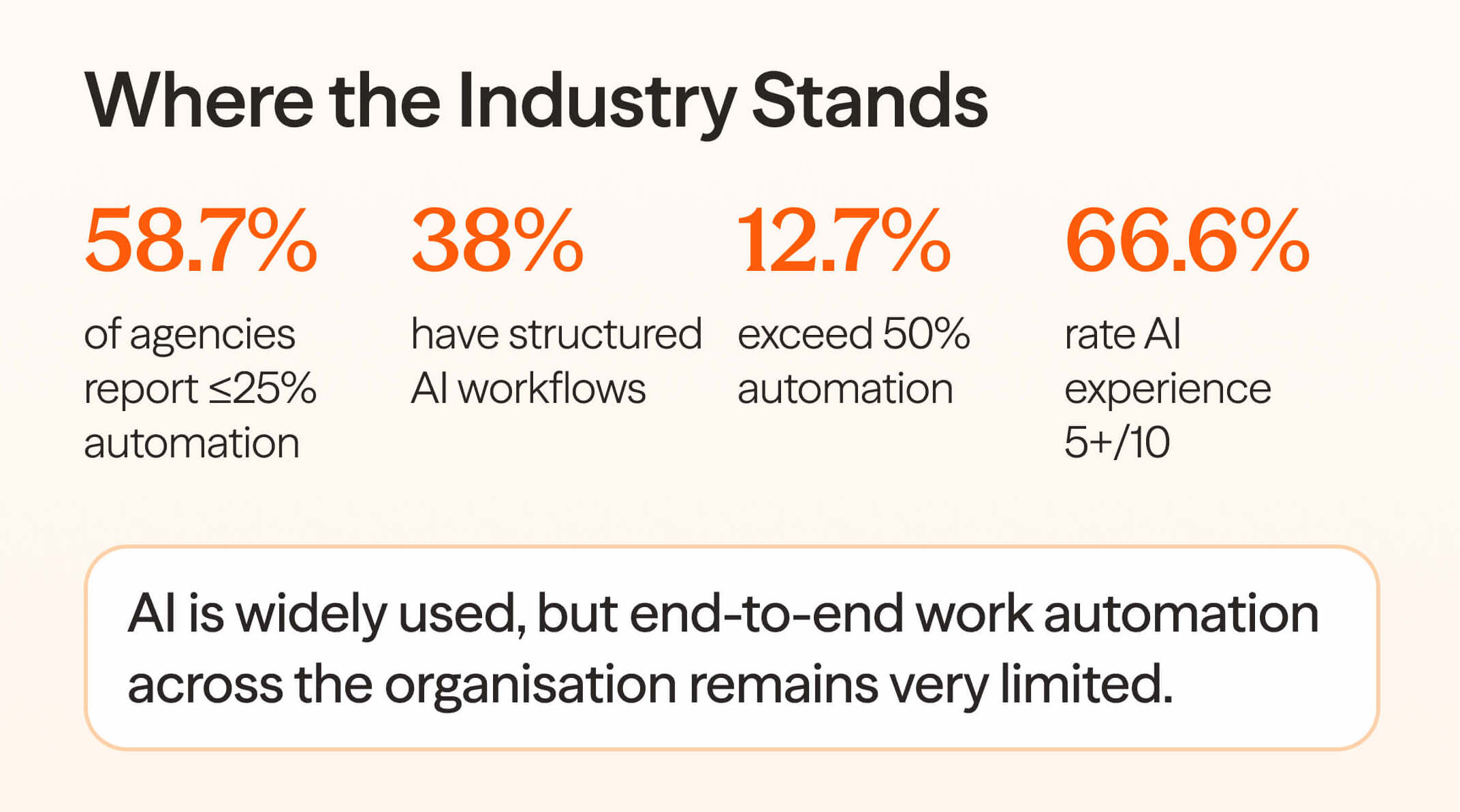
Why does it matter? A team using AI for copy drafts, reporting summaries, or media recommendations may improve productivity; however, it does not fundamentally change how work happens. Tasks become faster, but coordination often does not.
McKinsey’s broader enterprise AI research closely mirrors this pattern. While adoption continues to rise rapidly across industries, relatively few organizations report meaningful enterprise-wide redesigns around AI-enabled workflows (McKinsey & Company, 2025). Deloitte’s latest findings point to a similar tension: companies are moving beyond experimentation, but scaling AI across operations remains significantly harder than early implementation (Deloitte, 2025).
Agencies are feeling that tension directly as media operations become harder to coordinate. Spend now moves across fragmented platforms, retail media, connected TV, and performance channels that require constant optimization.
In theory, AI should simplify this environment. In practice, many agencies still rely on fragmented execution layers stitched together manually between teams, spreadsheets, approval systems, CRM exports, and reporting workflows.
The issue is usually not access to technology; it’s building workflows that remain reliable as automation spreads across teams and processes. Higher-maturity organizations tend to have clearer workflow structures, stronger system-to-system coordination, and greater automation embedded in day-to-day execution.
A standalone AI workflow can improve output. A connected operational system can improve scalability, delivery speed, cost structure, and consistency across the organization.
The industry is now entering a phase where AI adoption alone no longer signals competitive advantage. Increasingly, the more meaningful question is whether agencies are building systems capable of scaling automation across the business without creating additional coordination friction.
Why AI Adoption and AI Maturity Are Not the Same Thing
One of the biggest misconceptions in the current wave of AI disruption is the assumption that adoption automatically leads to transformation.
It does not.
An agency can deploy dozens of AI tools across teams and still operate almost exactly the same way it did before. In many cases, that is precisely what is happening. AI accelerates outputs, but the underlying workflow structure, decision-making process, and operational coordination remain largely unchanged.
This is the gap many organizations are now running into.
The first phase of adoption was relatively straightforward. Teams experimented with content marketing workflows, tested AI image generators, automated summaries, accelerated research, and improved content generation speed. Creative departments explored OpenAI’s DALL-E and Google’s Veo. Media teams leaned further into algorithmic optimization systems already embedded inside programmatic advertising platforms. Strategists used AI for search intent analysis, market research, and trend forecasting models.
The gains came quickly. Scaling them turned out to be much harder.
This is where AI automation maturity becomes a far more useful lens than adoption alone.
The real shift happens once automation starts changing how work moves across teams. That is the difference between AI as assistance and AI as operational infrastructure. Tools improve outputs. Systems change how the business operates.
That distinction becomes even clearer as agencies push AI deeper into recurring workflows.
Agentic AI systems are also pushing this distinction further. Increasingly, they coordinate actions across planning, optimization, reporting, and execution workflows rather than supporting isolated tasks individually.
That changes the challenge for agencies quite a bit. The limiting factor is no longer access to AI itself. Most teams already have access to capable tools. The harder part is building workflows and internal systems stable enough for automation to scale without creating new coordination problems underneath.
In many organizations, the technology is moving faster than the surrounding processes can adapt to it.
Broader industry research points to the same pattern. Deloitte’s enterprise AI studies show that while AI investment continues rising aggressively, many organizations still struggle to scale implementation beyond isolated use cases because governance, workflow integration, and organizational alignment evolve much more slowly than the technology itself (Deloitte, 2025).
Research from WARC and PHD suggests a similar dynamic inside marketing and advertising. Enthusiasm around generative AI remains high, but many organizations still face practical implementation challenges once automation moves beyond experimentation and into day-to-day operational workflows (WARC & PHD, 2024).
The agencies reporting the highest levels of AI automation maturity were not necessarily using tools that were dramatically different from those used by everyone else. More often, they had:
repeatable workflows,
clearer ownership structures,
connected operational systems,
stronger data integration,
and AI initiatives tied directly to business outcomes.
In other words, maturity had less to do with access to technology and far more to do with organizational design.
That shift changes how leadership teams should think about AI strategy entirely.
The real strategic question is no longer “Which AI tools should we use?” but rather “How do we redesign operations so automation compounds instead of remaining fragmented?”
Those are fundamentally different conversations.
Over time, they lead to very different outcomes.
The 3 Stages of AI Maturity in Advertising Agencies
Once the difference between AI usage and AI maturity becomes clear, another pattern starts emerging across the industry.
Advertising agencies are not simply adopting AI at different speeds. They are organizing automation in fundamentally different ways.
Some teams use AI mainly to accelerate tasks. Others are building repeatable workflows around recurring operational functions. A smaller group is pushing further, restructuring how work flows across planning, execution, reporting, optimization, and decision-making.
That progression serves as the basis for Capably’s AI automation maturity model.
The framework emerged less from tool adoption than from broader operational patterns in workflow design, automation depth, governance, and scalability. Across the surveyed organizations, most agencies clustered into three broad stages.
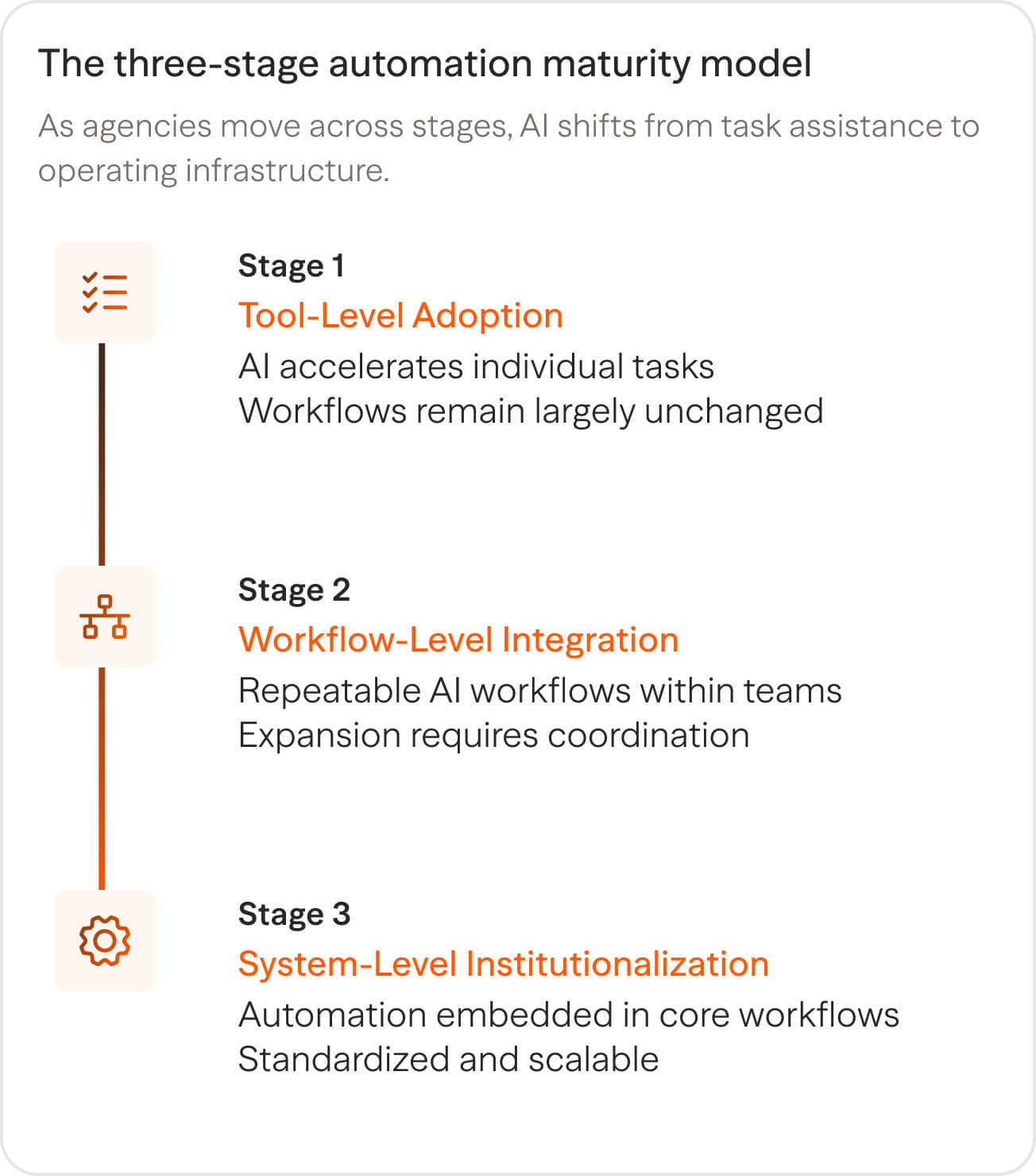
Importantly, these stages are not defined by the number of AI tools an organization uses.
They are defined by the extent to which automation changes the operating model.
Stage 1: Tool-Level Adoption
Despite the hype around AI, a large part of the industry is still operating here.
In practice, AI mostly acts as a productivity boost at this stage. Teams experiment with content generation, research support, reporting assistance, and image tools that help work move faster without fundamentally changing how the surrounding processes operate.
The benefits usually show up quickly. Content gets produced faster. Reporting takes less time. Research cycles shorten. But underneath, most workflows still rely heavily on manual coordination, undocumented processes, and individual team initiative. Some experiments work extremely well locally and still prove surprisingly difficult to scale across the rest of the agency.
This is also where many agencies mistake productivity gains for operational transformation.
In reality, AI often improves outputs faster than it improves operations.
Stage 2: Workflow-Level Integration
The second stage begins when AI stops living in isolated experiments and starts shaping recurring workflows across the business. This is usually where agencies start connecting automation to operational processes that happen repeatedly across teams and accounts. Paid media reporting, content production, campaign optimization, media planning, audience analysis, and other performance workflows are often the first areas where this shift becomes visible.
Teams begin linking CRM exports, ad campaign data, workflow triggers, proprietary data, and internal LLMs into more connected systems. Some workflows start scaling more reliably. Coordination gets easier in certain parts of the business.
At the same time, new friction begins to appear. Different briefing structures, approval processes, and reporting standards suddenly matter a lot more once automation spreads across multiple teams. A workflow that performs well in one department may become surprisingly difficult to replicate elsewhere without reworking parts of the surrounding process.
Usually, the issue is not a lack of enthusiasm for AI.
It is that automation demands a level of consistency across teams and workflows that many agencies were never originally designed around.
Stage 3: System-Level Institutionalization
Only a smaller group of agencies is operating here today.
AI no longer feels like a layer sitting on top of the business. It starts shaping how the business itself runs. Workflows begin connecting more naturally across teams, and reporting environments become less isolated from one another. Processes that once depended on constant manual coordination gradually become more repeatable.
Day-to-day work changes at this stage too. Teams spend less time chasing execution across disconnected workflows and more time reviewing outputs, interpreting signals, and making judgment calls around strategy and performance.
This is often where agentic AI starts becoming genuinely useful operationally. Systems begin connecting planning, reporting, optimization, and execution workflows in ways that reduce some of the manual coordination that sits beneath day-to-day operations.
That does not mean agencies suddenly become autonomous. Creativity, prioritization, client relationships, and strategic direction still rely heavily on human judgment. In many cases, those responsibilities become even more important as automation takes on a larger share of execution.
At that point, AI stops feeling like a separate collection of tools and becomes more directly embedded in how the agency operates.
Why the Maturity Model Matters
The point of a maturity model is not simply to categorize agencies. It is to make the underlying operational differences easier to see.
Many organizations still measure AI progress through surface-level signals:
how many tools teams use,
how often AI appears inside workflows,
or how quickly content production speeds up.
Those signals matter, but they can also be misleading.
We’ve seen agencies with high levels of AI activity still struggling with fragmented workflows, inconsistent processes, and underlying coordination bottlenecks. Others automate fewer areas initially but achieve far greater long-term scalability because their systems are more consistently structured across teams.
That is why AI automation maturity matters more than AI adoption alone.
The agencies likely to create long-term advantage will not necessarily be the ones experimenting with the most tools. More likely, they will be the organizations redesigning workflows and operational systems carefully enough for automation to scale consistently across the business.
Why Some Agencies Scale AI While Others Plateau
By now, most agency leaders have seen at least some evidence that AI can improve efficiency. Content gets produced faster. Reporting cycles shrink. Research takes less time. Campaign optimization becomes more responsive. Teams save hours across routine workflows.
The harder question is why those gains scale in some organizations while remaining isolated in others.
Many agencies experience what initially looks like strong AI momentum. Teams adopt new workflows quickly, early results are encouraging, and internal enthusiasm grows. Then progress slows. Automation stays concentrated within a handful of teams or individuals while the broader operating model changes very little.
More often than not, agencies plateau because their operational systems were never designed to support scalable automation in the first place. We’ve seen agencies build highly effective AI workflows inside individual teams that later became difficult to scale because surrounding processes were never standardized around them.
The organizations scaling AI most effectively tend to share a few structural traits:
repeatable workflows,
clearer ownership,
standardized operational inputs,
connected systems,
and stronger alignment between automation initiatives and business outcomes.
A team may build an effective workflow around content optimization or predictive analytics. A media buying group may automate parts of reporting and pacing management. Strategists may improve planning by analyzing customer behavior and using trend forecasting models. But when every workflow depends on different briefing formats, inconsistent data structures, manual coordination, or undocumented assumptions, scaling becomes difficult surprisingly quickly.
Successful workflows often end up being rebuilt repeatedly across teams.
Messy operations rarely become simpler under automation. Usually, the inconsistency just surfaces faster. Agencies with standardized systems tend to scale successful workflows far more effectively than organizations still operating through fragmented processes.
Over time, the gap widens.
What System-Level AI Actually Looks Like in Practice
One reason discussions around AI automation maturity often stay abstract is that “system-level AI” sounds more futuristic than what agencies actually experience day to day.
In reality, the shift usually starts with fairly operational changes.
You can often recognize these organizations quickly. Media plans no longer depend entirely on manual assembly across disconnected spreadsheets and reporting layers. CRM exports, historical ad campaign data, audience signals, and predictive insights begin feeding into more connected planning systems. Reporting workflows pull together paid media, connected TV, retail media management, and performance analytics into environments that update more frequently, reducing the need for constant coordination between teams.
Creative operations start changing, too. Some agencies build internal LLMs around brand voice, campaign history, and proprietary data environments to support more consistent content production at scale. Others integrate AI-assisted content optimization directly into workflow systems so creative variations adapt continuously based on performance signals.
The operational difference usually becomes most visible in areas like:
workflow orchestration across approvals and optimization cycles,
standardized reporting systems connected across channels,
AI-supported budget allocation,
and reusable automation frameworks that scale across accounts without requiring teams to redesign processes repeatedly.
None of this is especially futuristic anymore.
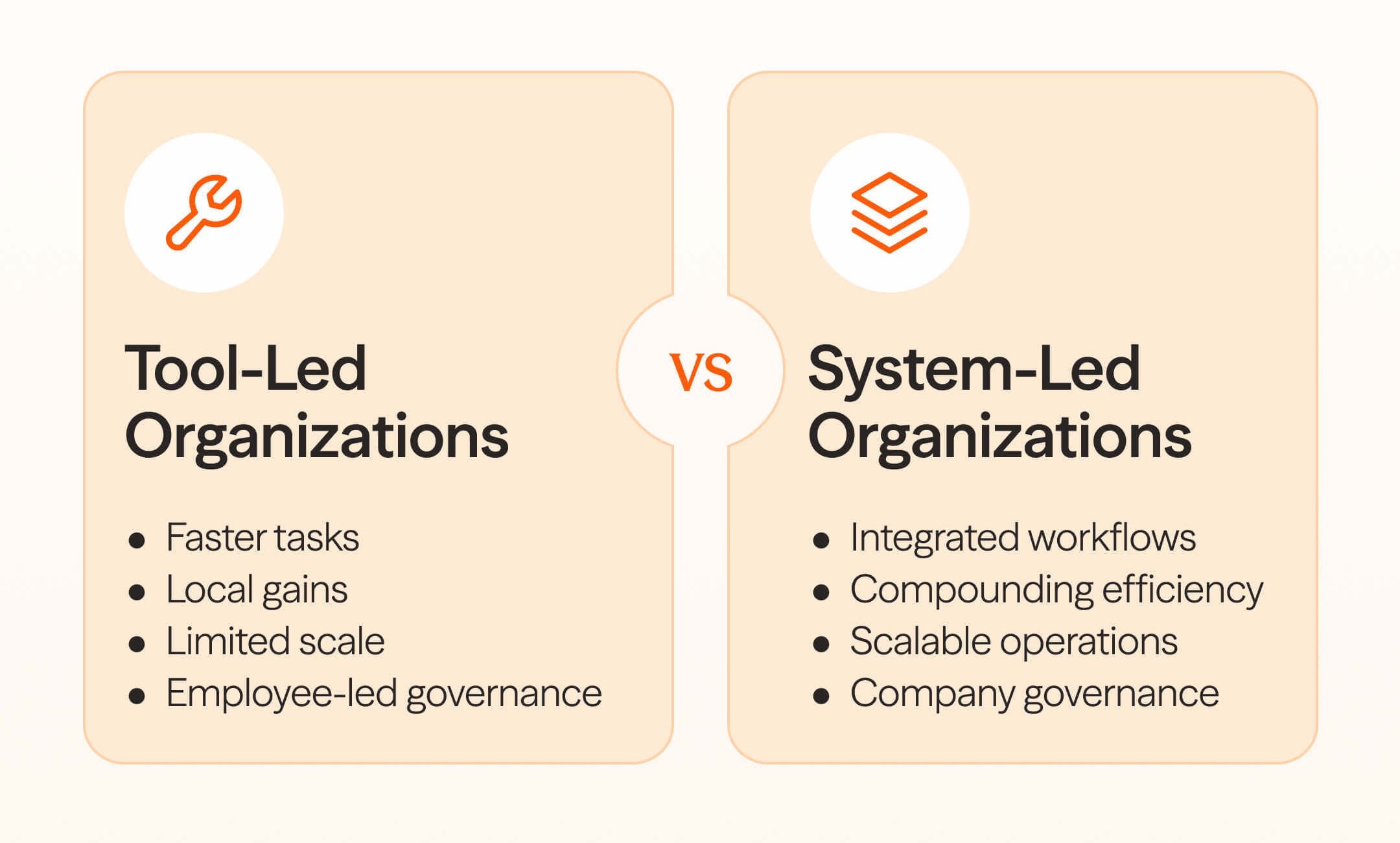
What matters is whether these workflows operate as connected systems rather than isolated automations.
That distinction changes scalability entirely.
A disconnected workflow may save time locally, but a connected system changes how the organization scales. This is where operational leverage stops sounding theoretical and starts becoming measurable.
The Operational Shift Agencies Underestimate
One of the less obvious effects of AI automation maturity is that it changes not only how work gets done, but also what agencies start valuing internally.
Early adoption usually revolves around speed. Teams produce more content, automate repetitive tasks, and reduce manual work across daily operations.
In practice, many agency leaders initially frame AI as an efficiency initiative. Over time, the conversation usually shifts toward coordination, governance, and workflow reliability instead.
Though, the challenge changes, as automation spreads.
The harder problem is no longer generating outputs quickly. It is building systems that remain reliable as more workflows, teams, and decisions begin to depend on them.
That shift is already becoming visible across the advertising world. Performance teams rely more heavily on automated optimization systems. Creative teams use AI-assisted content production to adapt campaigns more efficiently across channels. Reporting environments increasingly consolidate data streams automatically, rather than relying on analysts to manually assemble inputs across platforms.
When more repetitive work is automated, the roles of people within the workflow begin to change, too. Less time goes into repetitive execution. More time goes into judgment, oversight, prioritization, and making sense of what the systems are actually surfacing.
As automation spreads further into day-to-day operations, human judgment becomes more important, not less. The faster systems move, the more costly weak governance, inconsistent inputs, or unclear ownership become.
We’re already seeing this change in client expectations. Agencies are being pushed to move faster while maintaining visibility across increasingly fragmented media environments.
That probably does not lead to fully autonomous agencies anytime soon. More realistically, automation will take on a larger share of coordination and execution while human teams stay focused on strategy, creative direction, oversight, and client relationships.
In practice, the agencies that adapt best are usually not the ones experimenting with the most AI tools. They tend to be the organizations that redesign workflows carefully enough that automation can scale without creating additional operational friction underneath.
What AI-Ready Agencies Will Look Like Over the Coming Years
The next phase of AI in advertising will not be defined by adoption alone. Most agencies are already experimenting. What matters now is how deeply AI is built into the way work gets done.
A gap is starting to form between agencies that are reworking their operations around automation and those still adding tools on top of existing processes. As media continues to fragment across connected TV, retail media, creator platforms, search, and performance channels, that gap will become easier to see.
Agencies that integrate AI more directly into planning, reporting, optimization, and decision-making will start to operate differently, not just faster.
Over time, more connected systems are likely to bring advantages in scalability, responsiveness, and consistency that are difficult to match through manual coordination alone.
This does not mean agencies will become fully automated. The work still depends on judgment, creativity, and strong client relationships.
The agencies that move ahead will be the ones that rethink how their work operates underneath it all.
AI Is Moving From Capability to Infrastructure
For most agencies, the question isn’t whether AI matters anymore. That part is settled. It’s already embedded in day-to-day work, from content and reporting to campaign optimization. What’s starting to separate teams now is how they’re using it. In some cases, AI is still layered onto existing workflows. In others, it’s beginning to reshape how work actually runs.
The agencies pulling ahead are not necessarily the fastest. More often, they are the ones willing to rethink their workflows so automation can scale without adding new friction.
At this point, the shift goes beyond technology. It starts to change how the business itself operates.
As automation expands, human judgment becomes more important, not less.
AI is moving from capability to infrastructure, and the gap between agencies that operationalize that shift and those that don’t is starting to widen.
From what I’ve seen working with agencies, the challenge is rarely deciding whether to use AI. It is figuring out how to redesign the system of work so that automation actually compounds rather than fragments.
Capably’s full research report explores these patterns, the maturity framework behind them, and the operational changes already emerging across media and advertising organizations. If you are navigating that shift from experimentation toward more scalable, system-level automation, you can explore the full report or speak with our team to understand where your operations stand and what it takes to move forward.
References
Adobe. (2024). Adobe Digital Trends Report 2024. Adobe.
Deloitte. (2025). The state of generative AI in the enterprise: Q4 report. Deloitte AI Institute.
Deloitte. (2025). AI ROI: The paradox of rising investment and elusive returns. Deloitte AI Institute.
Deloitte. (2025). Tech Trends 2025: From hype to foundation — AI at the core of tech trends. Deloitte AI Institute.
Gartner. (2023). Understanding Gartner’s hype cycle. Gartner.
McKinsey & Company. (2025). The state of AI: Global survey 2025. McKinsey & Company.
Capably. (2026). AI automation maturity in advertising agencies: From experimentation to operational systems. As automation spreads further into day-to-day operations, human judgment becomes more important, not less. The
Continue reading